 This post is part of an ongoing series exploring the complexities of The Panchen Lama Controversy.
A political prisoner is someone who is out fighting for his or her people’s rights and freedom and is imprisoned for that alone. – Leonard Peltier
To begin with, the whereabouts of Gedhun Choekyi Nyima remain unknown. The available information—fragmentary, often contradictory, and filtered through political agendas—invites multiple interpretations. He may be alive, living either in Tibet or elsewhere in China, possibly with his parents or separated from them. He may be enjoying a quiet life under government supervision—or he may no longer be alive. The Chinese authorities either know his location or maintain ambiguity to preserve diplomatic face.
In the West, Gedhun Choekyi Nyima is widely regarded as the youngest political prisoner in the world, a status that has prompted repeated inquiries to Chinese officials. Yet no verifiable records—official or otherwise—confirm that he has been imprisoned or has ever engaged in political activism. He was, after all, only six years old when he disappeared. Ironically, the Chinese government’s statements claiming he is “living well” may simply be the truth, though unverifiable.
Regardless, his abduction has become a powerful symbol of the Chinese government’s repressive policies in Tibet. Since his disappearance, Chinese responses about his status have shifted inconsistently. The default position remains that he is alive, healthy, and wishes not to be disturbed. No foreign observer, however, has ever been granted access to him.
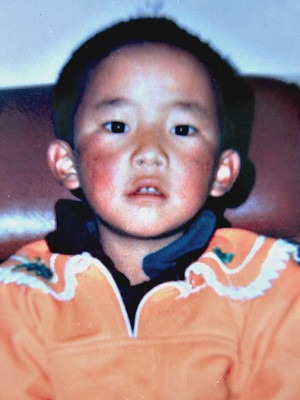 Beyond a single photograph—reproduced widely in books and online—very little exists in terms of confirmed imagery of Gedhun Choekyi Nyima. That image, taken in 1995 at age six, remains the only known visual record outside of China.
According to Isabel Hilton [B1], in 1995, the Dalai Lama received a clandestine package from Tibet at his residence in Dharamsala. Inside was a list of boys considered by the Tibetan search committee as candidates for the 11th Panchen Lama, along with over twenty photographs, including one of Gedhun. Hilton recalls: “I looked at the photograph of the child. He stared at the camera, his head slightly tilted back, his lips parted. He seemed to be sitting in one of those large, heavy brown-leather armchairs that used to be universal official furniture in China. He wore a dark blue shirt with an orange tunic over it. His eyes, widely spaced, betrayed nothing of whatever emotions he felt as that photograph was taken.”
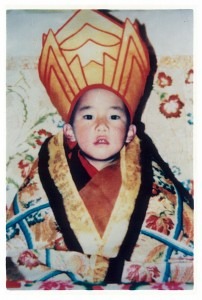 A second photo, depicting a boy in ceremonial golden robes and a yellow silk hat, was purported to show Nyima’s installation as the Panchen Lama. However, it was quickly debunked as a crude fabrication, with the child’s face copied from the original 1995 image.
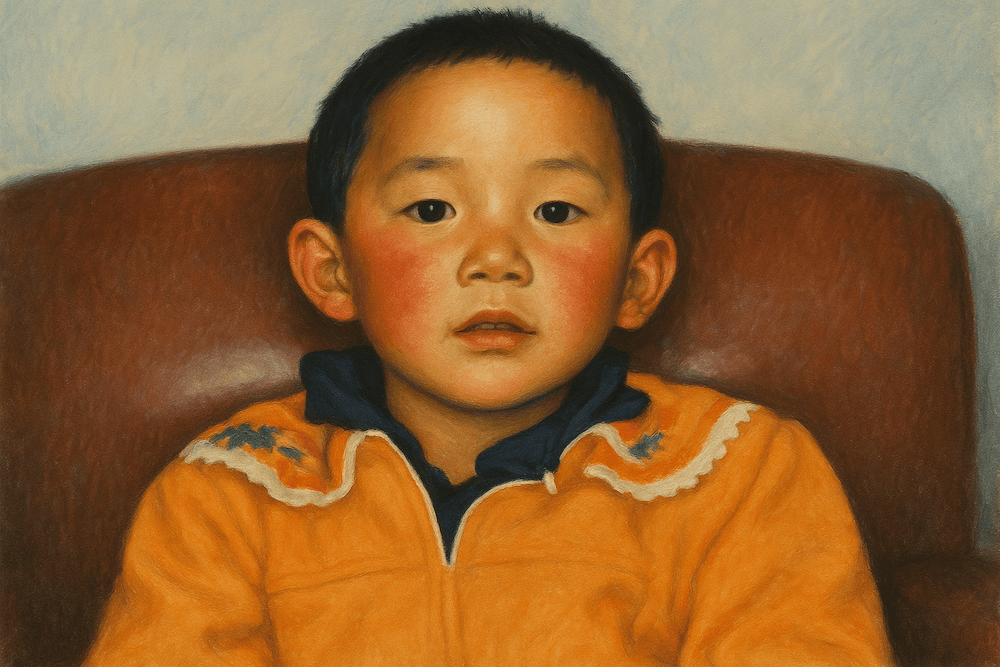
Note: The image on top of this page is an artistic rendering of the widely circulated photograph.
Most so-called “records” of Nyima are either rehashes or derivative content. Even the more credible sources are frustratingly vague, a result of China’s stringent information control. One notable exception is a forensic rendering commissioned by the International Tibet Network’s Political Prisoners Campaign Working Group. The image, portraying Nyima as a 30-year-old man, was created for the film Where is Panchen Lama? [A99]. This rendering continues to appear in articles—many published around his birthday, April 25, such as a Tibetan Review article dated April 26, 2019.
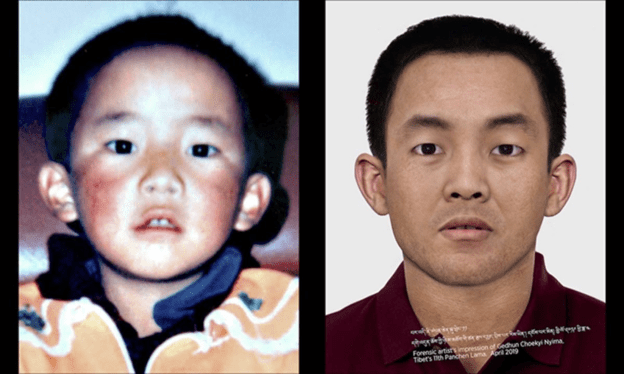
Note: Gedhun Choekyi Nyima was born on April 25, which explains why numerous articles and online posts were (and still are) published around that particular date. For example, the Tibetan Review post (What the China-disappeared 11th Panchen Lama might look like today), referencing the rendering, was published on April 26, 2019.
The only known official Chinese response to an inquiry about Nyima’s status came via the UN Committee on the Rights of the Child on May 31, 1996 [M1].
 When Things Fall Apart: Heart Advice for Difficult Times
Pema Chödrön’s timeless best-seller on navigating life’s challenges—now available in a newly designed 20th-anniversary edition with a new afterword by the author—is a powerful addition to any spiritual library or a thoughtful gift for those seeking inner peace.
How do we live when everything around us feels like it’s falling apart—when fear, anxiety, and pain dominate our lives? In her most cherished and acclaimed work, Pema Chödrön offers a surprising yet profound answer: rather than resisting our suffering, we can move closer to it. Through this courageous act of turning toward discomfort, we open our hearts in transformative ways.
Drawing on the wisdom of Tibetan Buddhism, Chödrön presents practical tools for breaking free from destructive patterns and embracing a life of compassion, resilience, and joy. More information…
Below is a (still incomplete) timeline of documented statements and developments, which illustrates the conflicting narratives offered by Chinese authorities and the speculation propagated by Tibet-supporting sources.
1996 (No specific date):
China has admitted for the first time that it is holding the missing Tibetan child, Gendun Choekyi Nyima, regarded by most Tibetans as the 11th reincarnation of the Panchen Lama. The UN has asked that a delegation be allowed to visit the seven-year-old boy, whom Beijing says is being held to prevent him from being kidnapped by Tibetan nationalists.
“He has been put under the protection of the government at the request of his parents,” China’s Ambassador to the UN in Geneva, Wu Jianmin, told UN experts who asked China on Tuesday, 28 May, to allow a UN representative to visit Gendun Choekyi Nyima. Ambassador Wu did not say where the child was being held.
“The Chinese ambassador said the boy, who has not been seen in public for more than a year, was in good condition and was living with his parents,” the official Chinese news agency reported in its account of the meeting in Geneva. “The boy was at risk of being kidnapped by Tibetan separatists, and his security had been threatened,” it said.
The admission comes just over one year after the child and his family disappeared and follows twelve months of denials by Beijing. Chinese officials “have no idea of the whereabouts of the soul boy designated by the Dalai Lama,” China’s Foreign Ministry spokesman told journalists last November.
Gendun Choekyi Nyima is believed to have been escorted to Beijing by Chinese security forces from his home in northern Tibet within days of the Dalai Lama’s announcement on 14 May last year that he had recognized the child as the 11th Panchen Lama, one of Tibet’s most senior religious leaders. [W7]
Note: The term “11th reincarnation” is incorrect in this context. The current Panchen Lama is the 11th incarnation and, thus, the 10th reincarnation.
May 31, 1996:
Mr. Wu Jianmin, the Permanent Representative of China to the U.N. between 1996 and 1998, provided answers to questions on the list of issues drawn up by the UN Committee on the Rights of the Child, as recorded on May 31, 1996. [M1]
With regard to reports concerning the controversy surrounding recognition of the Panchen Lama, he said that the Tenth Panchen Lama had passed away on 28 January 1989. Three days later, the State council had made a decision concerning the funeral and reincarnation of the Tenth Panchen Lama. He stressed that his Government respected the religious beliefs and sentiments of the broad masses of believers in Tibet.
A member of the committee, Mr. Hammarberg, asked for information on the whereabouts and situation of the Panchen Lama. Some people in Tibet felt that their religious freedom was not being respected. He asked if the Chinese Government would accept a fact-finding visit from outsiders with a view to making constructive suggestions on the problems in Tibet.
Mrs. Santos Pais echoed the concerns expressed by Mr. Hammarberg on the fate of the Panchen Lama. She emphasized that the Convention was directed at the rights of the individual child, and thus applied also to that particular six-year-old child, whose best interests, fundamental rights and freedom from discrimination on the basis of religious belief it was intended to protect.
Mr. Wu, referring to the question of the boy appointed by the Dalai Lama as the reincarnation of the Panchen Lama, said that in May 1995, a statement had been issued declaring that the Dalai Lama had violated traditional practice by appointing the boy abroad. Since separatists were seeking to kidnap the boy, the parents had become fearful for his safety and requested Government protection, which had been provided. The boy was living with his parents in good conditions.
“We know that he is studying now and living in quite good conditions,” he said. “His family members and him do not want to be disrupted in their normal life. We have to respect their wishes, so that’s why we don’t arrange visits with the young man. [A66]
June 29, 1999
The genuine article is 10-year-old Gedhun Choekyi Nyima, who, like his younger rival, lives in Beijing–but under house arrest. The 10-year-old, along with the rest of his family, has lived the life of a virtual prisoner since the Dalai Lama infuriated China’s leaders by naming him as the reincarnated Panchen Lama without their consent in May 1995. [A25]
November 12, 2002
A boy recognized by the Dalai Lama as the second-highest figure in Tibetan Buddhism and then placed under house arrest by China is “very happy”, a Chinese Government official has said. … The Beijing-appointed head of Tibet’s parliament said the boy was living with his family in Tibet. “He is living a very happy life,” said Raidi, who uses only one name. “He studies at school. His parents and entire family are happy.” … “He is 1.6 meters (5 ft 3 in) tall and weighs 65 kilos (144 pounds).” [A18]
February 13, 2006
In October 2000, during a round of the UK-PRC bilateral human rights dialogue in London, British officials raised the issue of Gedhun Choekyi Nyima. In a written report to the British Parliament, Foreign Office Minister John Battle stated that: “We pressed the Chinese to allow access to the boy by an independent figure acceptable to the Chinese government and Tibetans to verify his health and living conditions. The Chinese stated that the boy was well and attending school. They said that his parents did not want international figures and the media intruding into his life. Two photographs claimed to be of the Panchen Lama were shown to us but not handed over.”
During the meeting, Chinese officials displayed two photos from across the conference table: one of a boy writing in Chinese on a blackboard, and another of a boy playing table tennis. There was no means to positively identify the child, the photos merely showed a boy of approximately the correct age. There was also no means to determine his location. [W15]
April 23, 2006
The whereabouts of Gendun Choekyi Nyima — who human rights watchdogs say has been living under house arrest since Tibet’s exiled god-king, the Dalai Lama, appointed him the 11th Panchen Lama — is one of China’s most zealously guarded state secrets.
A senior Canadian official pressed for access to Nyima during a visit to Tibet this month, but it fell on deaf ears.
Chinese officials parroted their assertion that Nyima was “safe and comfortable and wishes to maintain his privacy,” said the Canadian, who requested anonymity. [A39]
April 25, 2009
On 15 May, 1996, the Chinese government admitted to holding the 11th Panchen Lama and his parents in their “protective custody”.
Tibetan Government-in-Exile claims that he and his family continue to be political prisoners, and have called him the “youngest Political prisoner in the world”. Others have referred to him as “Tibet’s Stolen Child”. [A65]
March 7, 2010
“As far as I know, his family and he are now living a very good life in Tibet… he and his family are reluctant to be disturbed… and they want to live an ordinary life,” Padma Choling, chairman of the Tibet autonomous regional government, told media at the National People’s Congress meet in Beijing. [A91]
July 1, 2010
According to Hao Peng, a deputy party secretary and vice chairman of the Tibet Autonomous Region:
“We know that he is studying now and living in quite good conditions,” he said. “His family members and him do not want to be disrupted in their normal life. We have to respect their wishes, so that’s why we don’t arrange visits with the young man.” [A66]
Note: This statement is very similar in content to that of Padma Choling, chairman of the Tibet autonomous regional government (See March 7, 2010 and July 11, 2010 entry).
July 11, 2010
And there remains the question of the whereabouts of Gedhun Choekyi Nyima, still the choice of Panchen Lama for many exiled Tibetans. China denies he’s in detention, with the recently appointed governor of Tibet, Padma Choling, reportedly telling AP on the sidelines of China’s annual legislative session: ‘As far as I know, his family and he are now living a very good life in Tibet… He and his family are reluctant to be disturbed, they want to live an ordinary life.’ [A15]
April 25, 2012
Speaking to Phayul over phone, an official in the Press Section of the Chinese Embassy in New Delhi today said that the XIth Panchen Lama Gedhun Choekyi Nyima is in “mainland China along with his family.”
“He is currently in mainland China along with his family and he doesn’t want to be disturbed,” the press officer, who declined from giving his name told Phayul.
When asked why the XIth Panchen Lama doesn’t want to be disturbed, the Chinese official, instead of giving a straight answer, blamed the Dalai Lama for “fabricating the truth.” [A1]
Note: Phayul.com (Tibetan for Fatherland) is a pro-Tibetan independence website that publishes news and opinions about Tibet and Tibet-in-exile. (Source: Wikipedia)
April 24, 2013
According to information received by Ven. Ngawang Woebar, the former President of Gu-Chu-Sum Movement of Tibet said, “His parents are currently placed under house arrest in their home town; they are not allowed to make any outside contact. Police officials are reportedly escorting and monitoring all their movements. Panchen Lama’s mother seem to have sadly expressed that she is the most unfortunate mother who has to live in constant fear and worry not knowing if her son is still alive or not.” [A16]
Note: A similar reference was made in another article on phayul.com published on the same date. [A13]
Any similar records on the whereabouts of Gedhun Choekyi Nyima in the years after 2013 are nothing more than empathic demands directed at the Chinese Government by means of online articles posted on Tibet-sympathetic websites.
April 27, 2018
The Dalai Lama has, on Apr 25, confirmed what Chinese leaders have been saying, most recently in 2014, that the 11th Panchen Lama Gedhun Choekyi Nyima recognized by him in 1995, is alive and pursuing normal education. The 11th Panchen Lama, “according to reliable source, is alive and carrying normal education,” he was quoted as saying, speaking to reporters on his return from New Delhi at Gaggal Airport.
He has also indicated that the existence of two 11th Panchen Lamas may not be all that unusual in Tibetan Buddhism. He was cited as having commented that there were instances in Tibetan Buddhist tradition where a reincarnate lama appeared as more than one person. [A100]
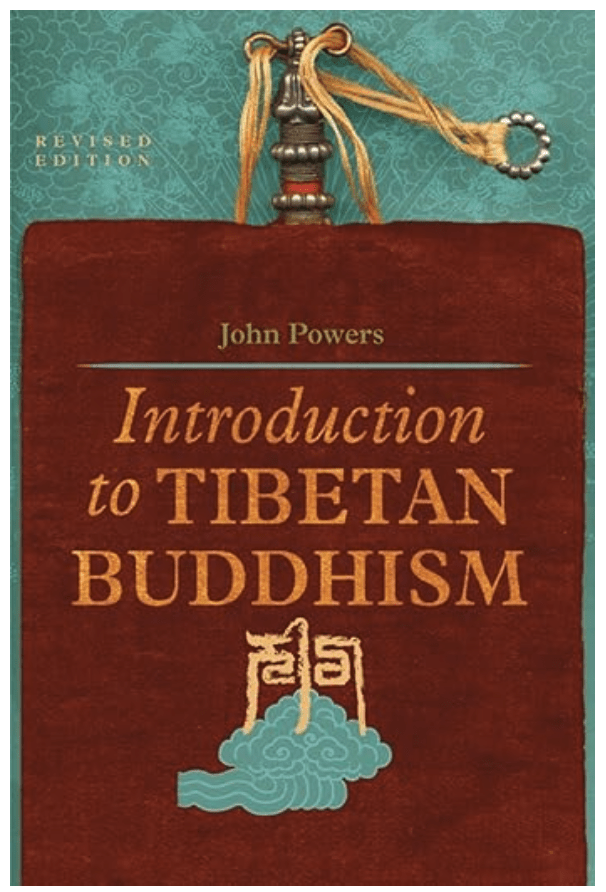 Introduction to Tibetan Buddhism
This revised edition stands as the most comprehensive and authoritative introduction to Tibetan Buddhism available today. It spans a broad spectrum of topics, including the tradition’s history, core doctrines, meditation techniques, ritual practices, major schools, religious festivals, and key historical figures.
The updated content features expanded discussions on modern Tibetan history and tantric practices, incorporating the latest scholarly research and publications. The book begins with an overview of Tibetan Buddhism’s Indian roots and traces its transmission into Tibet, offering an in-depth look at Mahayana philosophy and the transformative methods of tantra.
Each of the four major schools—Nyingma, Kagyu, Sakya, and Gelug—is explored in detail, alongside the Bön tradition, all presented from a balanced, nonsectarian perspective. This new edition is a clear, systematic, and accessible guide to the philosophical foundations and spiritual practices of Tibetan Buddhism—an essential resource for students, scholars, and curious readers alike. More information…