The question of the Panchen Lama remains one of the most unresolved and sensitive issues in modern Tibetan Buddhism. It is not a question of politics in the conventional sense, nor is it directed against a country or its people. At its core, it is about religious continuity, cultural survival, and the basic principle that spiritual traditions should be allowed to govern their own succession without coercion or disappearance.
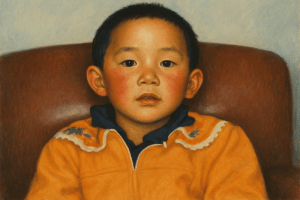
In 1995, the Dalai Lama recognized a six-year-old boy, Gedhun Choekyi Nyima, as the 11th Panchen Lama according to centuries-old Tibetan Buddhist tradition. Within days of that recognition, the child and his family vanished from public view. Since then, no independent observer has been permitted to verify his well-being. Chinese authorities have repeatedly stated that he is living a “normal life,” yet no evidence has been provided to support this claim.
In parallel, the Chinese government appointed another boy, Gyaincain Norbu, as the Panchen Lama. He has since been promoted within official state and religious institutions and appears regularly at government-sanctioned events. While this figure is recognized by the Chinese state, he is not accepted by the vast majority of Tibetan Buddhists, who see the Panchen Lama as a spiritual role determined by religious tradition, not administrative decree.
Why this matters extends far beyond one individual.
The Panchen Lama plays a crucial role in Tibetan Buddhism, particularly in the recognition of the Dalai Lama. With the current Dalai Lama now in his late eighties, questions surrounding succession are no longer abstract or distant. They are immediate and consequential. The Dalai Lama has spoken openly about various possibilities for his successor, including the prospect that it may be identified outside Chinese control, or even that the institution itself could evolve or end. These discussions are unprecedented, but they arise from a genuine concern: preventing spiritual authority from being reshaped by political power.
China has stated clearly that it intends to oversee and approve the selection of the next Dalai Lama, relying on regulations and historical interpretations that many scholars and practitioners dispute. In this context, the unresolved disappearance of Gedhun Choekyi Nyima becomes more than a human-rights concern; it becomes central to the future of Tibetan religious life.
It is important to emphasize what this discussion is not.
This is not an argument against China as a nation, its people, or its culture. Chinese civilization has a long and rich history, including deep philosophical and spiritual traditions of its own. Nor is this an attempt to frame the issue as a geopolitical contest. Rather, it is a call for clarity, transparency, and respect for religious self-determination—principles that are widely recognized across cultures and legal systems.
At minimum, the international community, religious leaders, and civil society groups continue to ask for one simple step: independent confirmation of Gedhun Choekyi Nyima’s status and well-being. Such confirmation would not resolve all disagreements, but it would address a decades-long absence that has come to symbolize something far larger than one child.
As the Dalai Lama ages and discussions about succession intensify, the Panchen Lama issue will only grow in significance. Whether Tibetan Buddhism can navigate this transition without external control remains an open question. What is clear, however, is that silence and uncertainty serve no one—not believers, not observers, and not the credibility of religious freedom in the modern world.
This is not a matter of taking sides. It is a matter of acknowledging that faith traditions, like languages and cultures, depend on continuity, trust, and openness to survive.
About This Website: Purpose, Scope, and Approach
This website – ThePanchenLamaControversy.com – is dedicated to documenting and explaining the Panchen Lama controversy and related questions surrounding Tibetan Buddhist succession. The subject is often discussed in emotional, polarized, or overtly political terms. Our intention here is different.
The goal of this site is to provide structured, verifiable, and context-driven information for readers who want to understand the issue without being pushed toward a particular political or ideological position. Wherever possible, we rely on documented events, official statements, historical records, and internationally recognized sources.
We recognize that topics involving religion, identity, and cultural continuity naturally evoke strong emotions. That response is understandable. However, this platform is designed to slow the conversation down rather than intensify it—to replace speculation with chronology, slogans with sources, and assumptions with clearly identified facts.
This does not mean the subject is treated as trivial or abstract. The disappearance of a recognized religious figure, questions of succession, and unresolved uncertainty are serious matters. But seriousness does not require polemics. It requires clarity.
This website is not directed against any nation, people, or culture. It does not seek to assign collective blame or promote confrontation. Its focus remains on transparency, historical continuity, and the right of religious traditions to explain themselves in their own terms.
Readers are encouraged to draw their own conclusions. The role of this site is not to tell anyone what to think, but to make it easier to understand what is known, what remains unresolved, and why the issue continues to matter.
In a discussion that is often reduced to soundbites and slogans, this site exists to provide space for careful reading, informed reflection, and informed dialogue.
 The World of Tibetan Buddhism: An Overview of Its Philosophy and Practice
With characteristic humility, His Holiness the Dalai Lama opens this landmark survey of the Buddhist path by observing, “I think an overview of Tibetan Buddhism for the purpose of providing a comprehensive framework of the path may prove helpful in deepening your understanding and practice.” That quiet understatement sets the tone for a work that is at once generous in spirit and rigorous in substance.
In these pages, the Dalai Lama offers a presentation that is both concise and deeply illuminating—welcoming to newcomers while still richly rewarding for experienced practitioners. Complex ideas are introduced with clarity and warmth, never reduced or oversimplified, but carefully placed within a broader spiritual context that makes them accessible and meaningful.
As readers are guided through the foundations, philosophy, and practices of Tibetan Buddhism, they encounter not only a comprehensive overview of the tradition, but also the distinctive voice of a teacher who speaks as much from lived experience as from scholarship. Throughout the book, His Holiness emerges as both a trusted guide and a compassionate companion—an authority whose wisdom is inseparable from kindness, and whose insights invite reflection rather than insist on conclusion.
The result is a work that deepens understanding without dogma, encourages practice without pressure, and leaves readers with the sense that Tibetan Buddhism is not merely a subject to be studied, but a path to be thoughtfully explored. More information…