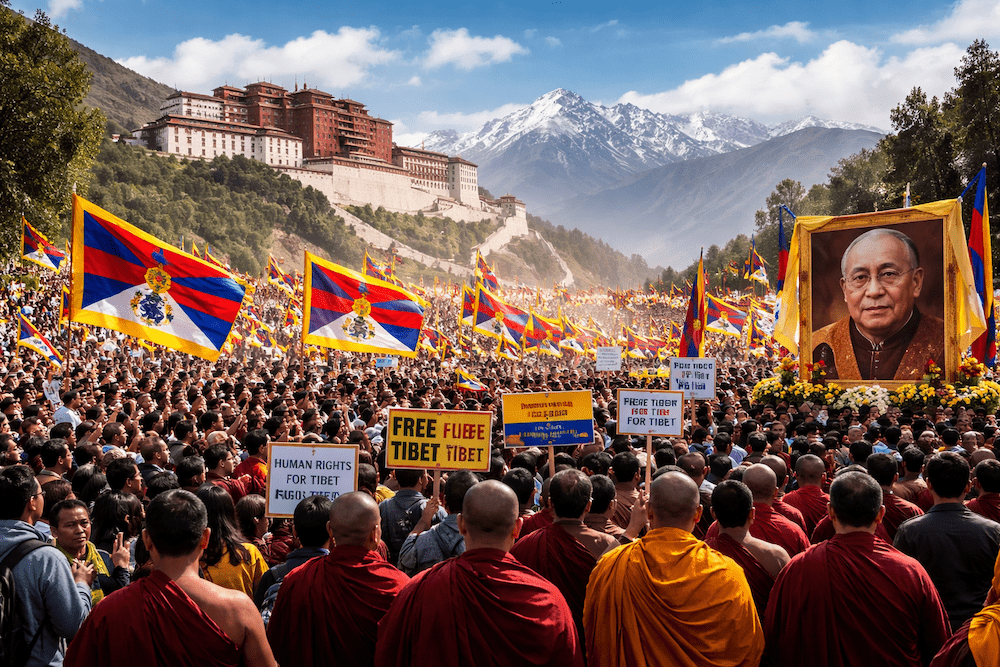
 Throughout March 2026, Tibet has once again drawn international attention across a range of political, cultural, and human rights developments. From commemorations of the 1959 Tibetan Uprising to renewed diplomatic activity by the Tibetan government-in-exile, recent reporting reflects both the enduring global relevance of the Tibetan issue and the evolving dynamics surrounding it. At the same time, articles highlighting restrictions on language, religion, and civil expression underscore ongoing concerns about conditions within Tibetan regions. The following selection of recent news coverage provides a concise overview of these developments and the broader context in which they continue to unfold.
1. Tibetan administration proposes Rs 341cr budget
Source: Times of India
Overview:
The Central Tibetan Administration (CTA), the Tibetan government-in-exile based in Dharamshala, presented a proposed budget of roughly ₹340.7 crore for the 2026–27 fiscal year. The announcement came during the ongoing parliamentary session, where leaders emphasized continued international support and the importance of preserving Tibetan culture and identity in exile. The session also included diplomatic engagement, such as meetings with an Australian solidarity delegation.
Link: Read article
2. Indo-Tibet commerce set to resume via Shipki La from June
Source: Times of India
Overview:
India announced plans to resume traditional cross-border trade with Tibet through the Shipki La pass, a route that has been closed since 2020 due to the COVID-19 pandemic. The reopening is expected to restore economic activity and revive historical cultural exchange between communities on both sides of the border, marking a significant development in regional relations involving Tibet.
Link: Read article
3. Global Tibet groups adopt “Dharamshala Declaration”
Source: Times of India
Overview:
At an international meeting in Dharamshala, over 100 representatives from Tibet support organizations across 32 countries adopted the “Dharamshala Declaration.” The statement calls for renewed global attention to human rights conditions in Tibet, advocates for cultural preservation, and urges governments to engage more directly with the Tibetan government-in-exile.
Link: Read article
4. Tibetans march against repression by Beijing
Source: Taipei Times
Overview:
Tibetans and human rights activists held demonstrations in Taipei marking the anniversary of the 1959 Tibetan Uprising. Protesters highlighted concerns about China’s repression of Tibetan culture and religion, as well as alleged transnational surveillance and pressure on diaspora communities. The march reflects ongoing global activism tied to Tibet-related human rights issues.
Link: https://www.taipeitimes.com/News/taiwan/archives/2026/03/08/2003853453
5. Don’t Forget Tibet on Anniversary of 1959 Lhasa Uprising
Source: Human Rights Watch
Overview:
This article highlights continuing human rights concerns in Tibetan regions, including arrests tied to protests, restrictions on cultural expression, and state surveillance. It places current developments in the context of the March 10 uprising anniversary, emphasizing that repression and detentions related to dissent and cultural preservation remain ongoing issues.
Link: https://www.hrw.org/news/2026/03/09/dont-forget-tibet-on-anniversary-of-1959-lhasa-uprising
6. Tibetan monk sentenced to six years for teaching language
Source: Phayul / Tibet This Week roundup
Overview:
Reports indicate that a Tibetan monk was sentenced to six years in prison for teaching the Tibetan language, reflecting broader tensions over cultural preservation policies in Tibetan areas. The case is seen by advocacy groups as part of a wider effort to limit the use of Tibetan language and identity in favor of Mandarin dominance.
Link: https://tibetbureau.in/tibet-this-week-2-march-8-march-2026/
7. Statement on the 67th Anniversary of the Tibetan National Uprising
Source: Tibet.net (Central Tibetan Administration)
Overview:
The Tibetan Parliament-in-Exile issued an official statement commemorating the March 10 uprising anniversary. The statement highlights ongoing diplomatic outreach, international advocacy efforts, and renewed global support, while framing Tibet’s political situation as urgent and unresolved. It also references international engagement, including U.S. policy coordination on Tibetan issues.
Link: https://tibet.net/statement-of-the-tibetan-parliament-in-exile-on-the-commemoration-of-the-67th-anniversary-of-the-tibetan-national-uprising/
8. Annual Taipei march marks Tibetan uprising
Source: Focus Taiwan
Overview:
Tibetans and supporters in Taiwan held their annual demonstration commemorating the 1959 uprising, emphasizing themes such as autonomy, religious freedom, and resistance to political pressure. The event also highlights how Tibet-related activism continues internationally, especially among diaspora communities.
Link: https://focustaiwan.tw/cross-strait/202603070010
 History of Tibet and Nepal: A Captivating Guide to Ancient Kingdoms, Spiritual Traditions, and Their Resilience Through Modern Times
Explore the histories of Tibet and Nepal—two Himalayan worlds shaped by faith, power, and resilience—brought together in one compelling volume.
Two manuscripts in one book:
History of Tibet: A clear and engaging account of ancient kingdoms, the rise of the Tibetan Empire, Mongol influence, the central role of Buddhism, the complexities of Chinese rule, and the realities of modern Tibet.
History of Nepal: A vivid journey through early Himalayan civilizations, the era of competing kingdoms, unification under a single crown, powerful dynasties, and the country’s transformation into a modern state.
Uncover the story of Tibet:
Trace Tibet’s early formation and the spiritual traditions that defined its identity.
Understand the influence of the Dalai Lama and the deep roots of Tibetan Buddhism.
Follow the rise of empires, the impact of Mongol rule, and shifting political powers.
Gain a straightforward view of Tibet’s incorporation into modern China.
See how Tibetan culture and identity have endured through decades of change.
Discover the history of Nepal:
Step into a land shaped by myth, trade, and mountain kingdoms.
Explore the dynasties that built Nepal’s temples, cities, and cultural legacy.
Witness the rivalry of competing kingdoms and the dramatic unification under Prithvi Narayan Shah.
Learn about the Thapa and Rana power structures that defined political life.
Follow Nepal’s transition from monarchy to republic.
Consider how a nation balances tradition with modern aspirations.
Why this book?
This is not a dense academic text. It is a readable, well-structured narrative designed to make complex histories accessible without oversimplifying them. Whether you are new to the region or looking to deepen your understanding, the book provides clarity, context, and continuity across centuries of change.
If you are interested in the Himalayas—its cultures, conflicts, and enduring traditions—this book offers a focused and engaging way to understand both Tibet and Nepal in a single, cohesive journey.
Begin exploring the histories that shaped the roof of the world. More information…