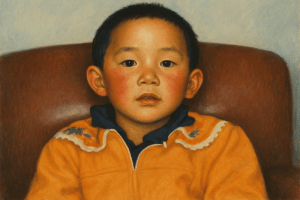
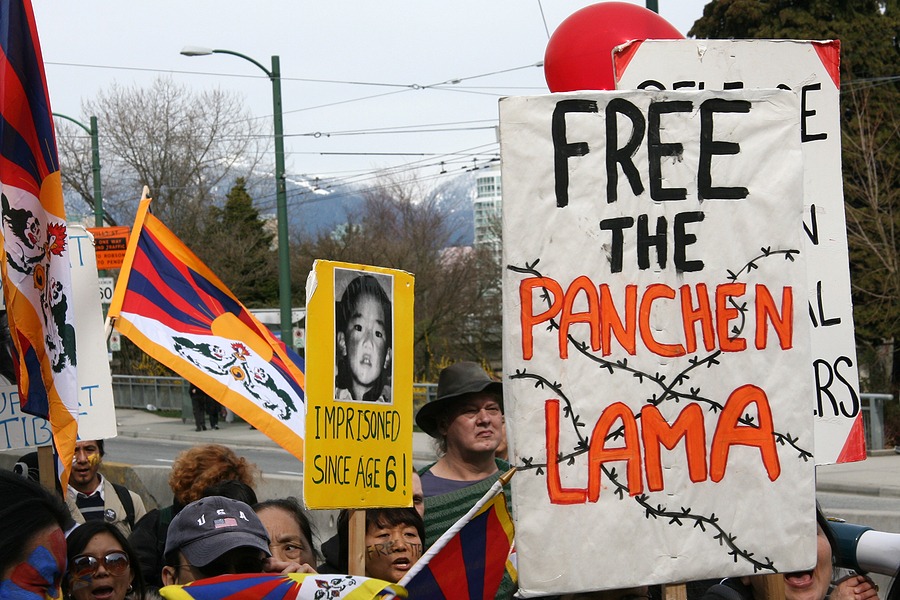
 This post is part of an ongoing series exploring the complexities of The Panchen Lama Controversy.
I have set myself on fire in fervent prayers for the return of His Holiness the Dalai Lama to Tibet, the release of Panchen Lama from the prison, and the well-being of six million Tibetans. – Tsultrim Gyatso, a 43-year-old monk of the Achok Monastery in Labrang Tashikhyil, who died after setting himself on fire on December 19, 2013.
Historical Roots of Tibetan Resistance
In 1950, the newly established People’s Republic of China sent troops into Tibet, asserting sovereignty over the region and defeating Tibet’s small army. Tibetan representatives were pressured into signing the “17-Point Agreement” in 1951, which affirmed Chinese rule but promised autonomy and religious freedom for Tibetans. Over subsequent years, Chinese policies – including land reforms and the stationing of PLA troops – fueled resentment among Tibetans who saw these moves as an attack on their traditional way of life and Buddhist religion. Tensions built throughout the 1950s, especially in eastern Tibet where armed resistance flared (with some covert support from the U.S. during the Cold War).
By March 1959, discontent in the Tibetan capital Lhasa erupted into a full-scale uprising. Fearing that Chinese authorities planned to detain the 23-year-old Dalai Lama, tens of thousands of Tibetans surrounded his palace, demanding China leave Tibet. Protesters clashed with Chinese forces in days of violence. The uprising was brutally crushed by the PLA: estimates by Tibetan sources and the International Commission of Jurists suggest around 87,000 Tibetans were killed during the 1959 revolt and its aftermath. The Dalai Lama, Tibet’s spiritual and political leader, escaped Lhasa on March 17, 1959 and fled into exile in India along with some 80,000 Tibetan refugees. From exile, the Dalai Lama repudiated the 17-Point Agreement, and Tibetans worldwide mark March 10 as National Uprising Day to commemorate the 1959 revolt.
Following 1959, Beijing dissolved the Tibetan local government and intensified control. Thousands of monasteries were closed or destroyed in the ensuing years (especially during China’s Cultural Revolution, 1966–76). Tibet was essentially sealed off from the outside world for two decades. By the late 1970s, China’s leaders under Deng Xiaoping allowed some reforms and even permitted exiled Tibetan delegations to visit. These visits revealed deep Tibetan loyalty to the Dalai Lama, contradicting Chinese officials’ claims that Tibetan people had accepted communist rule. This undercurrent of Tibetan discontent set the stage for renewed open resistance in the 1980s.
Major Tibetan Uprisings and Protests
The 1959 Lhasa Uprising and Its Aftermath
The 1959 uprising in Lhasa stands as a watershed in the Tibetan resistance. What began as a mass demonstration in defense of the Dalai Lama quickly turned into a rebellion against Chinese rule. Protesters erected barricades in Lhasa’s streets and fought Chinese troops with whatever weapons they had. After a few days of fighting, Chinese artillery shelled the Dalai Lama’s summer palace and overwhelmed the Tibetan rebels. By March 25, 1959, Chinese forces had fully seized Lhasa and suppressed the revolt. The crackdown was devastating: traditional Tibetan government institutions were abolished, and thousands were killed or imprisoned. The Dalai Lama’s flight into exile left Tibet leaderless, and Beijing appointed the young Panchen Lama (under Chinese influence) as figurehead in Lhasa. In the ensuing months and years, resistance shifted to guerrilla bands in Tibet’s borderlands, but by the mid-1960s open rebellion had been largely snuffed out. The United Nations General Assembly passed resolutions in 1959, 1961, and 1965 calling on China to respect Tibetans’ fundamental rights, but Beijing ignored these and tightened its grip. The legacy of 1959 was the permanent exile of the Dalai Lama and tens of thousands of Tibetans, and a festering resentment inside Tibet that would erupt again decades later.
The 1987–1989 Lhasa Protests and Martial Law
After a long period of relative quiescence under heavy-handed rule, Tibet saw a resurgence of resistance in the late 1980s. In September 1987, Buddhist monks from Lhasa’s great monasteries (Sera, Drepung and Ganden) staged bold demonstrations, shouting pro-independence slogans in the capital’s streets. These were the first large protests in Lhasa since 1959, and Chinese police reacted swiftly, arresting and beating many monk activists. Nonetheless, the protests emboldened more Tibetans. Demonstrations and sporadic riots recurred through 1988, often timed around politically sensitive dates. On March 5, 1988, for example, unrest in Lhasa led to clashes and a harsh crackdown by security forces. Foreigners in the city at the time reported troops firing on crowds and indiscriminate brutality.
Tensions peaked in early 1989. On March 5, 1989, riots broke out in Lhasa after police suppressed yet another demonstration. After days of chaos, Beijing had had enough. On March 7, 1989, Chinese Premier Li Peng formally declared martial law in Lhasa – the first time such a measure was imposed in Tibet since the 1950s. Thousands of PLA troops flooded into the city, checkpoints were set up on every block, and mass arrests of Tibetans followed. The regional Party Secretary at the time, a hardliner named Hu Jintao (who would later become China’s president), enforced a curfew and authorized troops to “quickly arrest” and punish protestors. Foreign tourists and journalists were expelled as the military sealed off Tibet from scrutiny. Although China never released official casualty figures, exile Tibetan sources claimed that Chinese forces killed scores of Tibetans during the 1987–89 protests. Martial law remained in effect for 13 months in Lhasa, until May 1990. These late-’80s protests and their suppression reawakened the Tibet issue on the world stage – the U.S. Congress, for instance, passed a resolution in 1987 urging China to respect Tibetan human rights and hold dialogue with the Dalai Lama. And in 1989, the Dalai Lama was awarded the Nobel Peace Prize, a recognition of his commitment to non-violent resistance even as unrest flared in his homeland.
The 2008 Nationwide Uprising
Nearly two decades later, Tibet exploded again. In March 2008 – on the anniversary of the 1959 uprising and just months before Beijing was to host the Summer Olympics – monks in Lhasa led peaceful marches calling for Tibetan freedom and the Dalai Lama’s return. Chinese security forces quickly quelled those monastery protests, but on March 14, pent-up anger boiled over into violent riots in Lhasa. Tibetan youths clashed with Chinese civilians and torched shops associated with Han Chinese and Hui Muslim migrants. After a day of mob violence, Chinese paramilitary troops moved in with overwhelming force – firing tear gas and live bullets according to many accounts. Dozens of Tibetans were reportedly shot or beaten to death in Lhasa, though Chinese officials claimed that about 18 civilians (mostly Han Chinese) were killed by rioters.
 Tibet’s Last Stand?: The Tibetan Uprising of 2008 and China’s Response
This book presents a definitive and meticulously researched account of the 2008 Tibetan uprising, which began with peaceful protests by monks from Lhasa’s historic monasteries on the anniversary of the 1959 revolt. Renowned Tibet scholar Warren W. Smith Jr. examines how these initial demonstrations quickly spread across the Tibetan plateau, evolving into the most widespread expression of Tibetan dissent in decades.
Smith argues that the uprising was not an isolated incident, but a sweeping and spontaneous response to long-standing grievances under Chinese rule—an unmistakable reflection of Tibetan nationalism and, perhaps more tellingly, a revealing portrait of Chinese nationalism. The Chinese government, interpreting the timing of the protests as an effort to embarrass Beijing ahead of the 2008 Olympics, responded with a harsh campaign of repression. This included mass arrests, the imposition of “patriotic education” in monasteries, sweeping censorship, and a propaganda offensive that blamed the unrest on the “Dalai clique” and alleged meddling by hostile Western forces.
In compelling detail, Smith shows how the 2008 uprising shattered any illusion that economic development alone could pacify Tibet. He contends that Beijing’s aggressive reaction was fueled by a belief that China’s rising global influence could now force the world to “thoroughly revise its mistaken knowledge” of Tibet’s history and current reality. Rather than seeking reconciliation, the Chinese government doubled down—intensifying efforts to extinguish Tibetan identity within its borders while pressuring the international community to conform to its official narrative. Smith’s analysis makes clear that the 2008 protests marked not just a crisis in Tibet, but a turning point in China’s approach to controlling the message at home and abroad. More information…
What made 2008 different was that the protests spread far beyond Lhasa. In the ensuing weeks, a wave of demonstrations rolled across the Tibetan plateau – in traditional Tibetan regions of present-day Sichuan, Qinghai, Gansu and Yunnan provinces. Over 150 separate protests were documented in 2008, from large towns to rural monasteries. Most of these protests were non-violent: crowds calling for freedom, monks marching with Tibetan flags, students demanding language rights. In some areas, however, anger erupted into attacks on police stations and government property. Chinese authorities responded with an iron fist across all Tibetan areas. According to Tibetan advocacy groups, over 100 Tibetans were killed in the 2008 crackdown and thousands were arrested. Entire towns were put under lockdown, and troop convoys occupied monasteries to purge suspected protest ringleaders. The authorities also imposed an information blackout – expelling foreign reporters and cutting internet and phone lines – to prevent news from leaking out. Despite the repression, low-level protests continued in Tibet in the months and years after 2008 (and sympathy demonstrations by Tibetans in Nepal, India, and the West garnered global attention during the Olympic torch relay). The 2008 uprising and its aftermath marked Tibet’s biggest upheaval in decades, and it galvanized a new generation of Tibetans, including those born under Chinese rule, to assert their identity and grievances.
The Wave of Self-Immolations
One of the most haunting forms of Tibetan protest in recent years has been self-immolation – Tibetans setting themselves on fire. This desperate protest phenomenon began around 2009 and escalated dramatically in the early 2010s. By the end of 2013, at least 124 Tibetans – monks, nuns and laypeople – had self-immolated to protest Chinese repression. (That number has since grown; as of 2022, around 150+ cases have been recorded.) These individuals typically call out for Tibetan freedom or the Dalai Lama’s return before succumbing to their injuries. Many have left behind notes or messages explaining their actions.
One powerful example was Tsultrim Gyatso, a 43-year-old monk, who burned himself to death on December 19, 2013. In a note he penned beforehand, Tsultrim Gyatso wrote of the anguish under Chinese rule: “Tibetan treasures of gold and silver have been looted under [China’s] suppressive rule… All citizens are driven to suffering… Tears drop from my eyes when I dwell on this state of sufferings. For the return of the Dalai Lama, the release of the Panchen Lama, and the well-being of six million Tibetans, I sacrifice my precious life in self-immolation.”. Such final testaments, often invoking the Dalai Lama and the Panchen Lama (the second-highest Tibetan religious figure, who was kidnapped by China in 1995 as a child), highlight that these acts are intended as political and spiritual sacrifices rather than suicides born of purely personal despair.
 Tibet on Fire: Self-Immolations Against Chinese Rule
Since the 2008 uprising, nearly 150 Tibetan monks, nuns, and laypeople have set themselves on fire in one of the most harrowing forms of political protest in modern history. These self-immolations, carried out across the Tibetan plateau, are a desperate cry against Chinese repression, cultural erasure, and the continued occupation of their homeland. Most of these protesters have died from their injuries, leaving behind final messages that call for freedom, religious rights, and the return of the Dalai Lama.
Tibet on Fire is a searing and courageous account by Tsering Woeser, one of the most prominent and outspoken Tibetan voices of her generation. Writing in Chinese—a bold act in itself—Woeser documents the realities of life under Chinese rule and gives voice to those whose acts of resistance have been silenced by state censorship and violence. Her essays explore the motives behind the self-immolations and challenge the Chinese state’s portrayal of these acts as terrorism. For her unflinching activism and refusal to be silenced, Woeser has endured ongoing surveillance and house arrest, becoming a symbol of peaceful resistance in her own right. Tibet on Fire is not only a chronicle of sacrifice and defiance, but also a deeply personal meditation on what it means to speak truth in the face of authoritarianism. More information…
By 2012, the self-immolation crisis had drawn international attention. The United Nations High Commissioner for Human Rights at the time, Navi Pillay, urged China to address Tibetans’ “deep-rooted frustrations” instead of meting out harsh punishment. Indeed, Tibetans who set themselves alight have called not just for an end to repression but for the world to hear Tibet’s plea. In these protests, no one else is harmed – only the protesters themselves – yet Beijing has reacted by labeling self-immolators as terrorists or criminals. The Chinese government has aggressively moved to punish friends, relatives, and communities of self-immolators, accusing them of abetting “crime.” For example, Chinese authorities have detained and beaten family members of those who burned themselves in protest, and even sentenced some alleged “accomplices” to prison. Rights groups point out that this collective punishment violates international law. Still, despite the intimidation, Tibetans continued to self-immolate throughout the 2010s, especially in Sichuan and Gansu provinces. Nearly all demanded cultural and religious freedom, and the return of the Dalai Lama, in their dying messages. The self-immolation protests – grim and tragic – have become a visceral symbol of Tibetans’ sense of desperation and their determination to press for their rights in the face of unyielding Chinese policies.
Acts of Civil Disobedience and Cultural Resistance
Not all Tibetan resistance is dramatic or overt; much of it consists of everyday acts of civil disobedience and efforts to preserve a threatened culture. In the decades since 1959, Tibetans have repeatedly engaged in non-violent protests, cultural revival movements, and subtle defiance of policies they view as unjust.
One major area of contention is language and education. Tibet’s distinct language is central to its identity, and Tibetan students and educators have pushed back against policies favoring Mandarin Chinese. In 2010, for instance, Tibetan students in Qinghai province took to the streets to protest the proposed replacement of Tibetan with Chinese as the medium of instruction. Throughout the 2010s, community initiatives sprang up to hold informal Tibetan-language classes and celebrate “Mother Language Day.” Posters appeared in Tibetan towns describing the Tibetan language as “the golden cup that holds the essence of Tibetan culture” and urging people to “defend their mother tongue”. Beijing’s response has been to shutter private language classes and, in some cases, jail Tibetan educators and writers. Simply speaking Tibetan or writing in Tibetan can be seen as an act of resistance, and Chinese authorities have imprisoned scores of Tibetan writers, artists, and singers for promoting Tibetan culture and “national identity” since the 2008 unrest. As one Tibetan activist observed, “the very act of speaking Tibetan has become a form of resistance” under Chinese rule.
Tibetans also practice their civil disobedience through their devotion to the Dalai Lama. It is illegal in Tibet to display the Dalai Lama’s photo or publicly praise him, yet many Tibetans secretly keep his portrait on altars or celebrate his birthday in private – quiet acts of dissent against the demonization of their beloved leader. In some areas, Tibetans have boycotted official celebrations imposed by the government. A notable episode of open defiance came in Driru County, Tibet Autonomous Region, in late 2013. When authorities ordered every household in Driru to raise the Chinese national flag, the residents flatly refused – some tore down Chinese flags and threw them into rivers or burned them. This remote county, long known for its independent streak, saw mass protests as people resisted the forced displays of loyalty. In one incident, a 68-year-old Tibetan named Dayang stepped forward during a tense standoff, held up a traditional white scarf, and shouted for Chinese cadres to leave Tibet. He was quickly beaten severely by armed police and later jailed for over two years. The Driru flag protests prompted a severe crackdown: paramilitary troops flooded the area and over a thousand Tibetans were arrested in subsequent months for various forms of defiance. Yet despite the risks, the refusal in Driru to hoist the Chinese flag showed the continued willingness of Tibetans to non-violently assert their identity.
Other forms of civil resistance include environmental and land rights protests. Nomadic herders and villagers in Tibetan regions have, on occasion, stood in the way of mining crews or dam projects that they believe desecrate sacred land. In Driru (again a hotspot), communities launched what is considered one of the most effective environmental campaigns, blocking mining operations they viewed as destructive. In some cases, local Tibetans wrote petitions to authorities to stop mining on holy mountains; in others, they physically protested at sites despite heavy security. These environmental and land protests tie into cultural preservation, as Tibetans see the land as intertwined with their spiritual heritage.
Tibetans also continue to express themselves through music, literature, and art in ways that subtly (or not so subtly) protest Chinese rule. Popular Tibetan singers have released songs praising the Dalai Lama or lamenting the erosion of Tibetan culture – songs that often land them in prison for “splittist” content. Painters and poets keep Tibetan history alive through their work, circulating it in samizdat form when necessary. Even Tibetan nomads adopting the Dalai Lama’s call to stop wearing animal furs (a campaign in 2006 to save endangered wildlife) was an act with political undertones – a way to show solidarity with the exiled leader’s wishes over Beijing’s indifference. In sum, everyday Tibetans resist by keeping their culture alive under a system that many feel is designed to assimilate and dilute their identity.
International Advocacy and the Exile Community
After the Dalai Lama’s escape in 1959, tens of thousands of Tibetans rebuilt their community in exile – primarily in India, Nepal, and Bhutan. Over the past six decades, this exile community has become the nerve center of international advocacy for Tibet. The Dalai Lama established a government-in-exile, the Central Tibetan Administration (CTA), in Dharamsala, India, which continues to function with a parliament and administrative departments for education, culture, and human rights. While no country officially recognizes the CTA as a government, it serves as a focal point for lobbying and keeping the Tibet issue on the global agenda.
Tibetan exiles and their supporters around the world have organized countless demonstrations and campaigns. For instance, each year on March 10 (Tibetan Uprising Day), rallies are held in cities from New York to New Delhi to remember the 1959 uprising and protest ongoing abuses. Tibetan flags – which are banned in Tibet – are openly waved, and slogans like “Free Tibet” and “China, talk to the Dalai Lama!” echo through the streets. In 2008, when China’s Olympic torch relay toured international capitals, Tibetan exiles famously turned out in droves to protest, often scaling bridges or unfurling banners to draw attention to Tibet even as Chinese security tried to keep the spotlight on the Games. Advocacy groups such as Students for a Free Tibet, the Tibetan Youth Congress, and International Campaign for Tibet have been instrumental in mobilizing global public opinion. They organize everything from school outreach programs to political lobbying on Capitol Hill and at the United Nations.
The diaspora has also worked to preserve Tibetan culture abroad. In India and Nepal, exile Tibetans have built monasteries, schools that teach in Tibetan, and archives of historical documents rescued from Tibet. This cultural resilience in exile sends a message to Beijing that Tibetan identity will endure. Furthermore, prominent Tibetans like the Dalai Lama travel widely (the Dalai Lama, until he reduced travel for health reasons, met regularly with world leaders and religious figures) to advocate for Tibet. Each such meeting – whether with a U.S. President, a European parliamentarian, or a global conference – is itself a form of pressure on China, which vehemently protests any official contact with the “Dalai clique.”
In recent years, younger Tibetan exiles have harnessed social media to raise awareness, and Tibet advocacy has intersected with broader human rights campaigns. A notable achievement of the exile advocacy was the passage of laws in some countries supporting Tibet: for example, the United States adopted the Tibetan Policy and Support Act (2020), which among other things affirms the rights of Tibetans to choose the Dalai Lama’s successor without Chinese interference. Parliamentary groups for Tibet exist in several nations, keeping lawmakers informed of Tibet’s situation. The exile community also reaches out to Chinese civil society abroad, attempting people-to-people dialogue by explaining Tibet’s story to Chinese students and dissidents – an effort to counter Beijing’s narrative.
While China’s economic and diplomatic clout often mutes governments’ responses, Tibetan international advocacy has had moral and symbolic successes. The Dalai Lama’s Nobel Peace Prize in 1989 was one such milestone, which brought global prestige to the Tibetan cause and implicitly rebuked China’s hardline tactics. Over the decades, the Tibet issue has been discussed at the United Nations, in the U.S. Congress, the European Parliament, and other forums largely due to the sustained efforts of the Tibetan exile community and its supporters.
Chinese Government Responses: Crackdown and Surveillance
Beijing’s response to Tibetan resistance – whether violent uprising or peaceful cultural expression – has been consistently heavy-handed. The Chinese government characterizes all Tibetan dissent as a separatist plot orchestrated by the “Dalai Lama clique,” and it has used a combination of military force, police crackdowns, intense surveillance, and propaganda to maintain control.
In the wake of each major protest – 1959, 1989, 2008, and others – China has sent in reinforcements and imposed security lockdowns. After crushing the 1959 revolt, the Chinese Communist Party launched “democratic reforms” that in practice dismantled Tibet’s social structure and enforced collectivization, leading to famine and hardship. In 1989, as noted, martial law kept Lhasa under curfew for over a year and was lifted only after Tibet was effectively saturated with security forces. Following the 2008 unrest, Beijing stationed permanent paramilitary units in numerous monasteries and towns. Thousands of surveillance cameras were installed across Tibetan urban areas – Lhasa became one of the most closely monitored cities in China. In 2011, the Chinese government rolled out a new “grid management” policing system in Tibet, creating a dense network of neighborhood police posts. Over 600 new police stations, equipped with high-tech monitoring tools, were built across Tibet by 2013 to keep watch on the populace. Officials openly spoke of creating “nets in the sky and traps on the ground” – an Orwellian security blanket designed to catch any sign of dissent. Special targets of surveillance include former political prisoners and Tibetans who have traveled abroad (for example, pilgrims who met the Dalai Lama in India are closely interrogated upon return). In addition to modern surveillance, traditional methods persist: a network of informants, and “Red Armband” volunteer vigilantes, help authorities watch Tibetan communities for any “troublemakers”.
 Chinese Propaganda on Tibet: A Documentary History
China has generated an extensive body of propaganda to justify its invasion and ongoing occupation of Tibet. This book presents a curated selection of the most significant examples of this propaganda—official articles, speeches, and policy documents—accompanied by a critical, contextual analysis. The recurring themes are familiar yet deeply revealing: that Tibet has “always” been an inseparable part of China, eliminating any legitimacy to Tibetan independence claims or the characterization of China’s entry as an “invasion”; that pre-1950s Tibetan society was a backward, feudal dystopia from which the Tibetan people were heroically “liberated” by the Chinese Communist Party; and that since then, China has acted as a benevolent force, fostering Tibet’s social and economic development without seeking any benefit in return.
These narratives also categorically deny the legitimacy of Tibetan nationalism, the right to self-determination, or any meaningful desire among Tibetans for political autonomy. Despite official claims that Tibetans are content under Chinese rule, decades of persistent resistance—including uprisings, protests, and acts of civil disobedience—tell a different story. Through a close reading of these propaganda materials, this book exposes the political and ideological frameworks underpinning China’s campaign to control the Tibetan narrative—both within its borders and on the international stage. It is a revealing look at how authoritarian regimes use history, language, and myth-making to maintain power and suppress dissent. More information…
When protests do occur, the Chinese state’s reflex is to impose an immediate information blackout. Internet and mobile phone blackouts are common during unrest, and foreigners (journalists or tourists) are swiftly expelled from protest zones. Security forces often seal off entire monasteries that are suspected of dissent – as happened with Kirti Monastery in Sichuan, which was the center of many self-immolations. Chinese law has also been used as a tool of repression: new criminal offenses have been created to prosecute Tibetan protesters. After the self-immolations began, China announced that anyone assisting or inciting an immolation would be charged with “intentional homicide” – effectively blaming friends of protesters for their deaths. Scores of Tibetans have been given long prison terms in opaque trials for simply sharing news of protests or sending information abroad.
Propaganda is another pillar of Beijing’s response. The Chinese government runs a constant media campaign to discredit Tibetan resistance. State media routinely portrays Tibet as having been “peacefully liberated” from feudalism by China, and it denounces the Dalai Lama as a “splittist” or even “an evil spirit with a human face and the heart of a beast”, in the words of one hardline Party Secretary. After the 2008 unrest, Chinese state television highlighted Tibetan rioters attacking Chinese civilians, but censored any mention of peaceful protests or the subsequent brutal crackdown. Tibetans are depicted in official narratives as grateful for economic development brought by China, with the implication that any dissent is the work of a few criminals or foreign-funded separatists. Education and patriotic re-education campaigns enforce these themes: Tibetan students must study in Chinese and learn a history that states Tibet has been part of China since ancient times, while monks and nuns are periodically forced to attend sessions denouncing the Dalai Lama.
In recent years, Beijing’s reach into Tibetans’ private lives has expanded with technology. Rights groups report that authorities require many Tibetans to install spyware on their smartphones, and police conduct random phone checks for banned content (such as exile songs or photos of the Dalai Lama). The surveillance state in Tibet is so pervasive that expressing dissent even in casual conversation or social media can lead to arrest. Despite international criticism, Chinese officials defend their actions in Tibet as necessary measures against “terrorism” and to maintain stability. The consequence is that Tibet today is often described as one of the most tightly controlled regions in the world – a place where a simple act like waving a Tibetan flag can land one in prison for years.
Global Reactions and Human Rights Concerns
The Tibetan struggle has resonated worldwide, eliciting responses from governments, international organizations, and civil society for decades. In the United Nations, Tibet has been a contentious topic since the 1950s: the General Assembly passed resolutions in the 1960s urging respect for Tibetans’ human rights. More recently, UN human rights officials have spoken out. In 2012, as Tibetan self-immolations mounted, UN High Commissioner Navi Pillay publicly urged China to allow independent observers into Tibet and to address the legitimate grievances of the Tibetan people. UN Special Rapporteurs have repeatedly requested access to Tibetan areas (requests that China has largely denied). At the UN Human Rights Council, a handful of countries have raised Tibet under agenda items, and in 2017 a statement on behalf of a human rights NGO pressed the Council to call for unfettered monitoring in Tibet in light of the self-immolation crisis. China’s delegation typically rebuts such criticism by insisting that Tibetans are “happy” and that any problems are caused by the Dalai Lama’s separatism.
Human rights organizations have been even more vocal. Groups like Amnesty International and Human Rights Watch (HRW) regularly document abuses in Tibet – from arbitrary arrests and torture of prisoners, to religious repression and the forced relocation of nomads. After the 2008 crackdown, Human Rights Watch issued a scathing report accusing Chinese forces of using excessive force, including torture and extrajudicial killings of Tibetan protesters. Amnesty International condemned the “harsh crackdown on peaceful protesters” in Lhasa and urged accountability. These organizations also track the status of prominent Tibetan political prisoners and campaign for their release. One example is the case of the Panchen Lama, who at age six was detained by Chinese authorities in 1995 and has not been seen since; the UN and rights groups periodically call on China to divulge his fate.
Foreign governments face a delicate balance in responding to Tibet, given China’s economic clout, but there have been notable stands. India has hosted the Dalai Lama and the Tibetan exile community for decades, though it officially recognizes Tibet as part of China. Nepal, under pressure from Beijing, tightly restricts the activities of Tibetan refugees on its soil, often breaking up protests. In Western countries, Tibet enjoys considerable public sympathy, if not formal diplomatic recognition. The United States from the 1980s onward adopted policies supportive of Tibetan human rights – as early as 1987, the US Congress affirmed that China’s treatment of Tibetans should factor into U.S.-China relations. Washington annually issues statements urging China to preserve Tibet’s unique heritage and to engage in dialogue with the Dalai Lama’s representatives. The U.S. government also appoints a special coordinator for Tibetan issues and has sanctioned Chinese officials for abuses in Tibet in recent years. Europe has seen a mix of responses: the European Parliament has passed resolutions condemning religious repression in Tibet, and individual European leaders have met the Dalai Lama (incurring Beijing’s wrath). For example, Germany, France, the UK and others have at times summoned Chinese ambassadors to convey concerns after crackdowns. In 2012, the European Union expressed deep concern over the wave of Tibetan self-immolations and urged both sides – Tibetans and Beijing – to show restraint, calling on China to address the underlying causes of the protestspost-gazette.com.
Some international initiatives have specifically focused on Tibet’s cultural rights. UNESCO and academic communities abroad quietly keep an eye on the preservation of Tibet’s cultural heritage sites (like Lhasa’s historic architecture, which has been threatened by modernization). Meanwhile, a global advocacy campaign called Stand Up for Tibet (launched by Tibet supporters) has collected signatures from political leaders worldwide asking China to halt repression and open Tibet to the world.
It is worth noting that no country officially recognizes Tibetan independence – most adhere to a “One China” policy that acknowledges Beijing’s sovereignty. However, many governments state that Tibetans should enjoy a high degree of autonomy. Calls for negotiations between Beijing and the Dalai Lama have come from the highest levels: U.S. presidents and EU officials have repeatedly encouraged China to resume the dialogue (which was intermittently held in the 2000s but stalled without progress). In the diplomatic arena, Tibet remains a sensitive issue that China considers off-limits, yet it surfaces regularly as a barometer of China’s human rights record.
The international Tibet movement also includes numerous grassroots organizations and celebrities who champion the cause. From Hollywood actors to Nobel laureates, many have used their platforms to call attention to Tibet. Concerts, films, and books about Tibet have further internationalized the issue. While such soft power advocacy irritates Beijing, it has helped keep young generations around the world aware of Tibet’s struggle.
In summary, Tibetan protests against Chinese rule have taken many forms – from armed rebellion and mass uprisings to solitary acts of self-immolation and quiet cultural resistance. China’s response has been unyielding, relying on force and surveillance, even as it touts economic development in Tibet. The stalemate endures: Tibetans inside Tibet continue to test the limits of dissent, and their exiled compatriots amplify their voices globally. The issue of Tibet remains a flashpoint for human rights, testing the international community’s commitment to defending a small nation’s identity in the shadow of a great power. As Tibetans often say in defiance, “Bod rangzen!” – “Free Tibet!” – a cry that has not been silenced despite the decades of rule that they have endured.
Sources
- University of Central Arkansas Political Science – “China/Tibet (1950–present)” (Chronology of Tibet conflict)uca.eduuca.edu.
- Radio Free Asia (via Friends of Tibet NZ) – “Respected Tibetan Monk Burns Himself to Death in Gansu” (Dec 20, 2013)friends-of-tibet.org.nzfriends-of-tibet.org.nz.
- International Campaign for Tibet – UN Human Rights Council Statement on Tibet (June 2017)savetibet.orgsavetibet.org.
- Radio Free Asia – “Chinese-Flag-Resisting Driru County Keeps Tibetan Struggle Alive” (Jan 15, 2014)rfa.orgrfa.org.
- Radio Free Asia – “Push to Preserve the Tibetan Language in China” (Feb 25, 2013)rfa.orgrfa.org.
- Human Rights Watch – “China: Alarming New Surveillance, Security in Tibet” (Mar 20, 2013)hrw.orghrw.org.
- Jamestown Foundation – Warren W. Smith, “The New Face of Civil Disobedience in Tibet” (China Brief, 2008)jamestown.orgjamestown.org.
- International Tibet Network – “Tibet Protests 2008” (2008 summary report)tibetnetwork.orgtibetnetwork.org.
- Tibet Watch – “30 Years of Resistance: The Legacy of the 1987 Lhasa Protests” (Sept 17, 2017)tibetwatch.orgtibetwatch.org.
- Central Tibetan Administration – “A Row Over the Internationalisation of the Tibet Issue (1987–1990)”tibet.net.