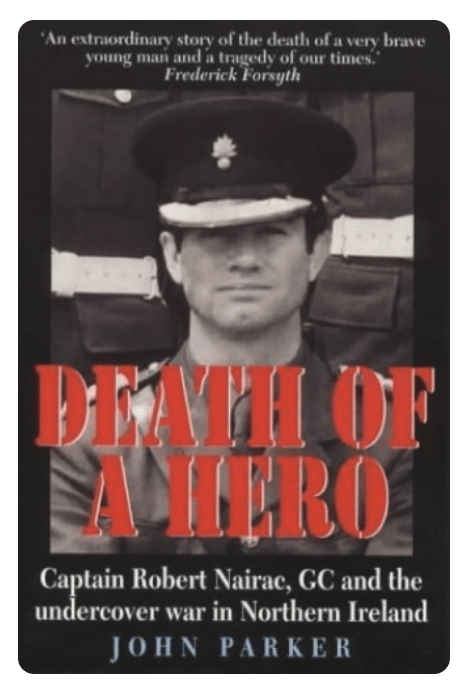
British Army Captain Robert Nairac fought his own war on the streets of Seventies Belfast, heading out on patrol with a cowboy hat, trainers and a pump-action shotgun. His undercover activities won him both the George Cross and accusations of treachery, but doubt surrounds almost everything he did.
“Listen, let me tell you about him, his secret operations in Northern Ireland and his eventual disappearance,” says a former high-ranking military source. “It’s simple: Nairac didn’t just stick his head into the lion’s mouth — that wouldn’t have been enough for him. Instead, he had to go and stick it right up the lion’s arse.”
Captain Robert Nairac was a British Army undercover operative in the Seventies. The details of his notorious life remain obscure to this day, but it is known that he died after being abducted by an ”IRA gang” outside a South Armagh bar, and that he was savagely attacked, beaten and tortured before his death on 14 May 1977. His body has never been found. He is the only soldier among Northern Ireland’s “disappeared” — those killed by paramilitaries whose bodies remain missing.
“There’s still a chill to the name: Nairac,” says one former military colleague. “It sounds mysterious, even sinister. Then again, there are the series of connections — the soldier who was a Grenadier Guardsman connected to the Queen… the SAS… the fact that he was on his own when he died. The overtones of Lawrence of Arabia. These all build up into a modern-day spy figure.”
Of all the soldiers who have served in Northern Ireland, Robert Nairac is one of the few who sticks in people’s memories and still, almost 25 years on, sparks intrigue and controversy. Perhaps it’s because he attempted to alter events single-handed during one of the most violent periods of the Troubles. Or because he was an English Roman Catholic who had an insight into both sides of the conflict.
To some, he was the ultimate undercover soldier, heroically fighting a deadly, duplicitous war in which he bravely penetrated both Republican and Loyalist paramilitary groups, laying himself open to attack from both in the process. Others see him differently. They express disgust at his posthumous award of the George Cross for gallantry (after the Victoria Cross, the highest honour that can be given). They allege that he ”ran” violent agents inside opposing paramilitary groups, that he stopped following the rules he once respected, and that he vanished while fighting his own private war.
Establishing a fuller picture is difficult. Many figures in the British military top brass choose not to discuss his case, and Northern Irish Republicans prefer to say as little as possible. His death reflects well on neither. Yet it’s undoubtedly true that Nairac was a complex individual taking part in a truly dirty war.
Robert Nairac was born in Gloucestershire in 1948, into a solidly middle-class English family. His father was a distinguished eye surgeon and a Roman Catholic; his mother was Protestant. His early years were spent at Gilling Castle, a remote prep school in Yorkshire; he then boarded at Ampleforth College, the English Catholic equivalent of Eton. During his time at Ampleforth, he excelled in both academic and sporting fields. The countryside around the school also allowed him to pursue his great love of shooting, wild-fowling and fishing. He was sociable but often craved solitude.
 Far left, Nairac excelled at sports during his time at Catholic public school Ampleforth College.
Left, Nairac [center] as a youthful Grenadier Guards officer in the early Seventies.
He went on to study medieval and military history at Oxford, where he stood out from the crowd. He kept a trained hawk in his bedroom, sat exams wearing full Grenadier Guards uniform, and boxed for his college. Contemporaries considered him single minded and charismatic; some also noted an air of doom around him.
A brief holiday in Ireland while at Ampleforth led to Nairac developing an enduring love of the country. In 1972, after training at Sandhurst military academy and joining the Grenadier Guards at Wellington Barracks in London, Nairac volunteered to serve in Northern Ireland. While most soldiers tried to avoid the province, Nairac saw it as somewhere he could make a mark.
Arriving in March 1973 to join No 1 Company, 2nd Battalion Grenadier Guards, he entered a conflict that couldn’t have been more violent and volatile. At the time, British soldiers were being targeted by the newly armed Provisional IRA; the British military responded with more men, more weapons and even torture, at the notorious Castlereagh interrogation centre. The rules were changing: “Bloody Sunday”, when members of the Parachute Regiment shot dead 13 people in January 1972 and the IRA’s response six months later, “Bloody Friday”, during which Belfast city-centre car bombs killed nine people, had seen to that.
The Army was exploring other anti-IRA options. A more vigorous intelligence war was initiated, involving RUC Special Branch, MI5 and MI6, and outfits such as the notorious Force Research Unit; interdepartmental rivalry was commonplace. The stakes were high: units such as the Mobile Reconnaissance Force used “turned terrorists” (so-called “Freds”) as spies.
At first, Nairac was simply a soldier patrolling the tense streets of both Protestant East and nationalist North Belfast. As a Catholic, it seemed a natural move for him also to volunteer for some “hearts and minds” initiatives in the nationalist areas, helping out at a youth club and teaching boxing.
When his battalion pulled out for Hong Kong on 31 October 1973, Nairac remained to work as a liaison man for incoming colleagues. The adrenaline of walking the streets seemed to have flicked a switch inside his brain, and he no doubt sensed that the real war was an intelligence one. He volunteered for intelligence training at the Joint Intelligence College in Kent, followed by training with the SAS at Hereford, then survival courses in the UK and Kenya.
In early 1974, he was sent back to Northern Ireland to be attached to a new group called “14 Int”, or “The Det”. This was one of the most feared organisations operating in the North; many IRA killings blamed on the SAS were in fact carried out by The Det, although recruits were often seconded SAS men.
“Robert Nairac was very much the new boy,” says a colleague. “He stuck out like a sore thumb because he was a public schoolboy and looked it.” Another colleague detected a darker side in the new recruit: “He still looked like a Guardsman, but there was another element which made me think that I couldn’t quite trust the guy or begin to work him out.”
Det operators had to live on their wits, often deep inside enemy heartlands. They infiltrated at street level, watching and waiting, gathering intelligence from the ground up. When paramilitary weapons or explosives were found they weren’t seized, but bugged (or “jarked”) for monitoring. Nairac had to transform himself, dropping the Guardsman’s bearing and developing a rougher appearance; one wrong word, gesture or action could mean death. For days, weeks, even months on end, Nairac had to think and act like his enemies.
Carving out a niche as a charming rogue, Nairac took on the role of liaison officer within 14 Int, linking Army and intelligence units and finding information in the “intelligence desert” of the border area of South Armagh. Major Clive Fairweather, who served in the top-level intelligence post of G2/Int inside the Lisburn-based British Army HQ in Northern Ireland, knew Nairac and is very clear that, despite many claims to the contrary, Nairac was never an SAS man. He was only attached to their unit and had never gone through full SAS training.
Nairac later hooked up with another shadowy group, which used the cover name “4 Field Survey Troop, Royal Engineers” and acted separately from other soldiers and units. This was a covert organisation of experienced and professional operatives. MOD files on this group, which was based near a stately house at Castledillon, County Armagh, are alleged to have vanished.
Now in possession of a passable Irish accent, Nairac resolved that his role was to infiltrate both terrorist groups and he began to frequent IRA and Loyalist bars in the North. These were dangerous places for undercover men, yet Nairac refused backup, his only company being that of his black Labrador, Bundle. He tried to meet terrorist agents and join local units. One source told me Nairac infiltrated a Loyalist group, only to betray them to Republicans: “He was doing the classic thing, what intelligence corps always try to do: ‘running the enemy’.”
In 1974, Robert Nairac met Julian “Tony” Ball, a serving SAS man attached to 14 Int and operating out of South Armagh. Ball, an ex-Para, was described to me by one former colleague as “genuinely ruthless — and in some ways I think Nairac modelled himself on him”. Another source put it bluntly: “Ball was a nasty bit of work — a psychotic, I would say. He bit his fingernails down to the white half-moons and was living on his nerves continually, possibly taking drugs.”
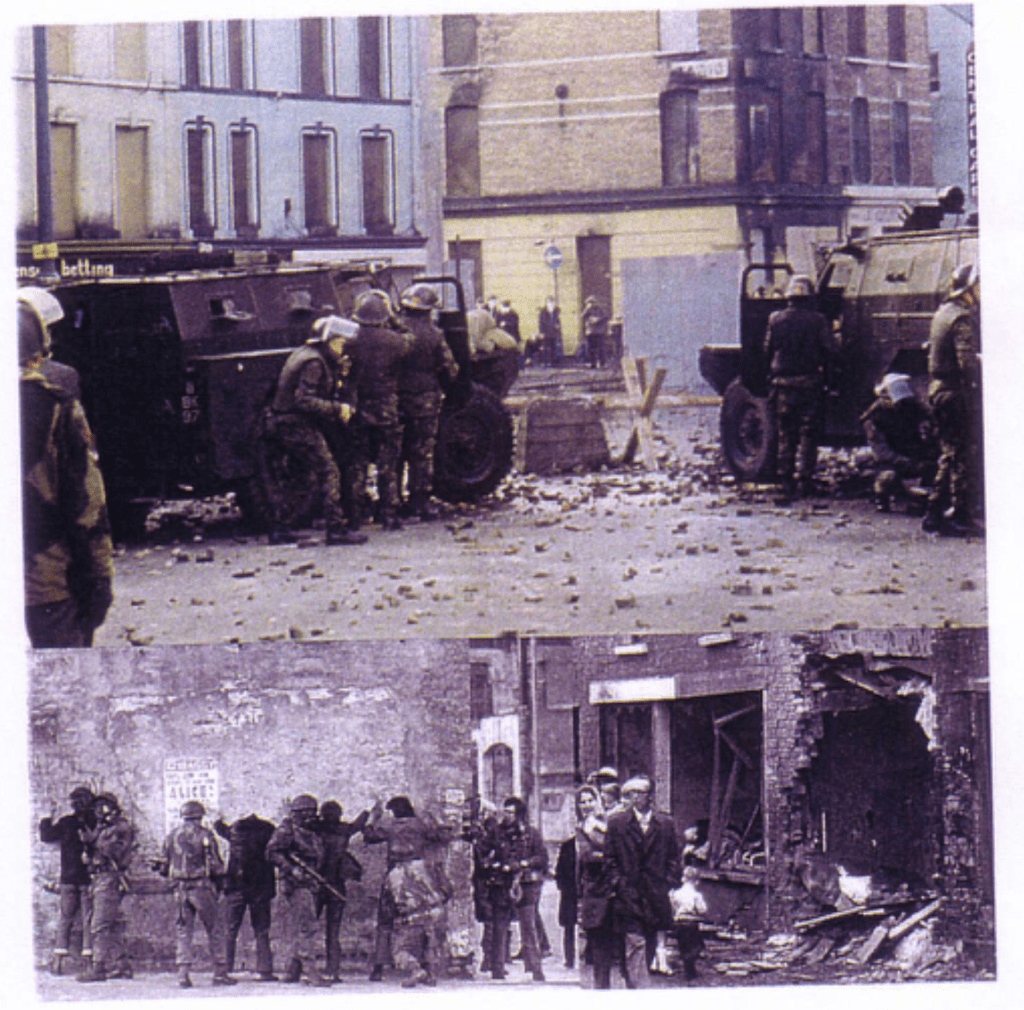 Clockwise from top:
Stand-off on Bloody Sunday, 30 January 1972, when British Troops killed 13 civilans;
Anderson Street, Belfast, on 28 May 1972, after a bomb attack in which eight people died;
British Army soldiers frisk marchers on Bloody Sunday.
The pair worked closely together for about a year during a turbulent period for Northern Ireland, and controversy still surrounds their activities. Both have been linked, for example, to the worst single day of atrocity in the entire Troubles: the 1974 bombings in Dublin and Monaghan, which killed 33 people (the 1998 outrage in Omagh saw 29 victims murdered).
Solicitors representing the families of victims of these bombs have recently examined secret British Army documents that lead them to believe British military intelligence groups used Loyalist groups as agents provocateurs. It is alleged that the bombs were planted by Loyalists aided by an “out of control” British Army intelligence faction seeking to show Dublin that if it wanted to share power, it would also have to share pain, and as a warning to the area to stop acting as a haven for Republican terrorists.
Certainly, the Garda (the Irish police) knew within 72 hours of the bombs being detonated that the cars used were from Loyalist areas of Northern Ireland. Within weeks they had identified prime suspects, all of whom were known members of the Mid-Ulster UVF (and all of whom are now dead, many as a result of terrorist activities). Dublin passed this information on to Belfast but no arrests or court appearances followed. However, experts have agreed that the UVF did not have the expertise to organise the detonation of three car bombs within 90 seconds and with 100 per cent effectiveness; only a military operation could achieve that.
Government authorities in Dublin have secret papers that point to British military involvement. A Dublin solicitor told me British correspondence from the time suggests “the Dublin and Monaghan bombings had been connected to a group known as the Protestant Action Force, or Protestant Task Force, which was controlled by a special duties team from the British Army HQ in Lisburn. It has been known for some time that a special British Army unit operated in Armagh in 1974 under the title of 4 Field Survey Troop.” Nairac was in that group.
One of the contacts between Nairac and these Loyalists was Fred Holroyd, a retired military-intelligence officer who was formerly attached to Portadown Special Branch. He met Nairac in Portadown in 1974 and knew he was working for a special unit. Holroyd links Nairac with the Portadown UDA and claims Nairac was “with them on planning sessions for terrorist outrages”.
Holroyd was told that UDA members from Portadown had carried out the Dublin and Monaghan bombs. Does that mean, I asked him, that Robert Nairac and Tony Ball could have been directly involved? “Yes — very, very easily,” he replied. “ln fact, highly likely. I’d be surprised if they weren’t.” A 1993 Yorkshire Television First Tuesday documentary also alleged that Nairac was ”running” three Loyalists who were suspected of being agents in the Dublin and Monaghan bombs.
It has also been claimed that Nairac and Ball were involved in the cross-border assassination of Republican gunman John Francis Green in January 1975. While the actual killers have never been caught, and uncertainty surrounds this claim (one intelligence source told me that Ball was too much of a loner to have taken Nairac with him), Fred Holroyd is in no doubt that this was a joint Nairac/BaII mission. “I know they did it because Robert told me,” says Holroyd. “He pitched up in my office and said, ‘Well, we’ve topped John Francis Green,’ and I told him I didn’t believe him. Then he produced a Polaroid photograph of the killing as proof and described in great detail how they’d done it. He even asked me if I’d like to come along on the next one.”
While one source claims that Nairac had a drawer full of gruesome scene-of-crime shots, this particular photograph has been the subject of much dispute. David McKittrick, Northern Ireland correspondent of The Independent, has claimed it was, in fact, a Garda picture taken after the killing and that it couldn’t have been in Nairac’s possession. Investigative journalist Duncan Campbell, however, maintains that the image is genuine and that the Irish police didn’t own a Polaroid camera in 1975.
Fred Holroyd alleges that Nairac was following orders, possibly from MI5 or another area of the British intelligence community. “1 think there were hidden agendas in his being deployed in Ireland,” he says. Holroyd believes that Nairac was being run directly by someone back in England, someone with enough power to also control the Northern Ireland SAS if they became too curious about Nairac’s secret missions and overall agenda.
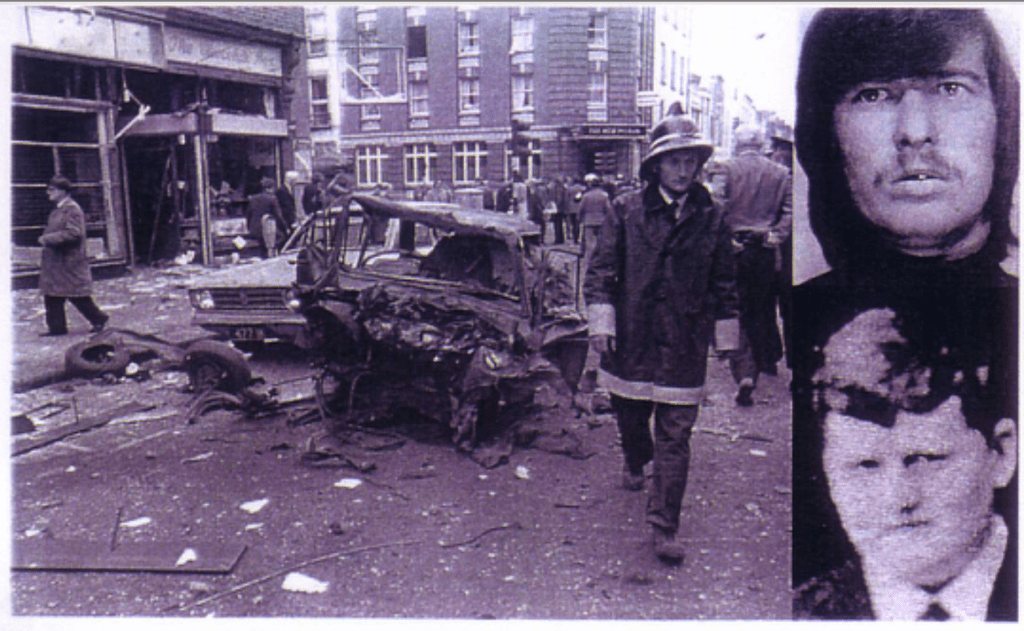 Clockwise from far left:
Talent Street, Dublin on 16 May 1974 after a car bomb attack;
Peter Cleary, shot by the SAS, possibly at the behest of Nairac;
John Francis Green, an IRA man whose assassination wsa linked to Nairac.
Nairac’s name has also been linked to the massacre of pop group the Miami Showband near Newry in July 1975. A pistol linked to the John Francis Green killing was used in the killing and an English accent was said to be heard among the eight UDR-dressed UVF terrorists. Yet the case against Nairac for this atrocity is thin.
Fred Holroyd, however, went on to make another, previously unpublished, accusation against the Nairac and Ball SAS-trained team: “I think he [Nairac] was a nice young chap, as keen as mustard to do well, but I also know that he was killing people before he came to me. I know from the information and evidence I have received that Robert Nairac and Tony Ball were working together and that certain officers of the British Army complained to a commanding officer that he [Nairac] was going out with Ball in the evenings — shooting Catholics one night and Protestants the next. They were using an unmarked car and were dressed in plain clothes, but they were carrying sub-machine guns and pistols.”
Holroyd alleges that the commanding officer in question threatened his superior with resignation unless Nairac was stopped. He also claims that Nairac and Ball’s aim had been to break an MI6-negotiated truce that had led the IRA to declare a series of ceasefires. Holroyd’s source for this allegation was described to me as “a very senior Army officer, just retired”. He alleges this source established his bona fides by quoting to Holroyd “large chunks” of Holroyd’s own Top Secret MOD file, to which only top-level personnel would have access.
In the summer of 1975, on military orders, Nairac and Ball were split up. Nairac returned to London; Ball later left the Army and followed a private military career in the Middle East. He died at the age of 38, in a 1981 car accident in Oman, serving as the lieutenant-colonel commanding the Sultan’s Special Forces.
With the IRA taking their war to the UK by bombing, murdering and hostage-taking, London was a dangerous place for an off-duty undercover operative. Yet Nairac was often to be seen hanging out in Irish pubs in Kilburn, practising his accent and starting fights. It seemed that the mission, the draw of a dark and dangerous undercover Northern Ireland, was beginning to control and define the man.
Then, in January 1976, 10 Protestant workers in Armagh were murdered by a Republican hit squad in what became known as the Kingsmills Massacre. One Catholic worker was ordered away from the scene before the bloodbath. As a result, the SAS were officially sent into Northern Ireland by PM Harold Wilson. This was a pivotal point in Robert Nairac’s life. Sent back to the province as a liaison officer with an SAS detachment, he was briefed to make contact with all the relevant intelligence outfits and report back to the SAS. The newly arrived SAS — not all of whom liked this outsider who occasionally affected their regimental beret — needed his help. “He was a powerful character and there was a lot going on inside his head,” says ex-SAS man Major Clive Fairweather. “He produced lots of useful information.”
Yet for the next year or so, between the departure of one SAS unit and the arrival of the next, Nairac waged his own, highly dangerous war. By night he would go undercover to local bars; during the same day, he’d walk the streets in patrol uniform, occasionally adding a cowboy hat, trainers or extra pieces of non-issue gear, such as a shoulderholster, a Wingmaster pump-action shotgun and jumpboots. To describe this as reckless would be generous. Perhaps Nairac simply thought he was different, that the normal rules didn’t apply to him, or that he was so well “fin” with both sides that he had ruled himself out as a target. Perhaps he was working to a secret agenda. Perhaps he was out of control.
It’s alleged that his antics soon led to two high-profile incidents for the SAS. In March 1976, IRA man Sean McKenna is alleged to have been woken in his cottage in County Louth, just a mile and a half across the border, with an SAS gun to his temple. He was then frogmarched from the Republic into the North. McKenna was held in remand for 16 months; he came to trial on 14 May 1977, the same day Robert Nairac disappeared. In April 1977, IRA member Peter Cleary was “arrested” and killed while allegedly lunging for an SAS man who was holding him captive; forensics suggested a very different scenario. Cleary arrived at a British Army base dead and was loaded into a body bag. The man rumoured to have fingered him that night was Robert Nairac.
The Three Steps Inn at the edge of Drumintee is still open today. This part of South Armagh has been dubbed “bandit country”, a label the locals resent, yet more soldiers have died in South Armagh than any other part of Northern Ireland and even now, in the peace process, the British Army never patrols here on foot. The IRA’s South Armagh recruits are regarded as their most deadly, and their bombing expertise renowned: the 1996 Docklands bomb, for example, which caused £1bn worth of damage, two deaths and 33 injuries, was planned near here. Today, it is a recruiting ground for the “Real IRA”.
What happened to Robert Nairac on the night of his death is disputed. One theory is that Nairac came to The Three Steps to infiltrate local Republican circles. If true, it was contrary to everything he’d ever been taught. Fred Holroyd, however, believes that Nairac may have been acting the way he did because he felt relatively safe: “Well, he didn’t have to worry, did he? He was talking to these people. He was actually serving them up Protestants.”
What is known is that Nairac left his base at Bessbrook Mill barracks, around 15 miles to the north, in an unmarked, military issue car and drove directly to the bar. Just as he had when visiting the pub the night before, he broke off radio contact with the base before arrival. He ordered a pint of Guinness and talked to locals. Characteristically, Nairac went out of his way to be noticed; he joined the pub band to sing Irish rebel songs. It was his way of hiding in plain sight – or signaling his presence to a contact.
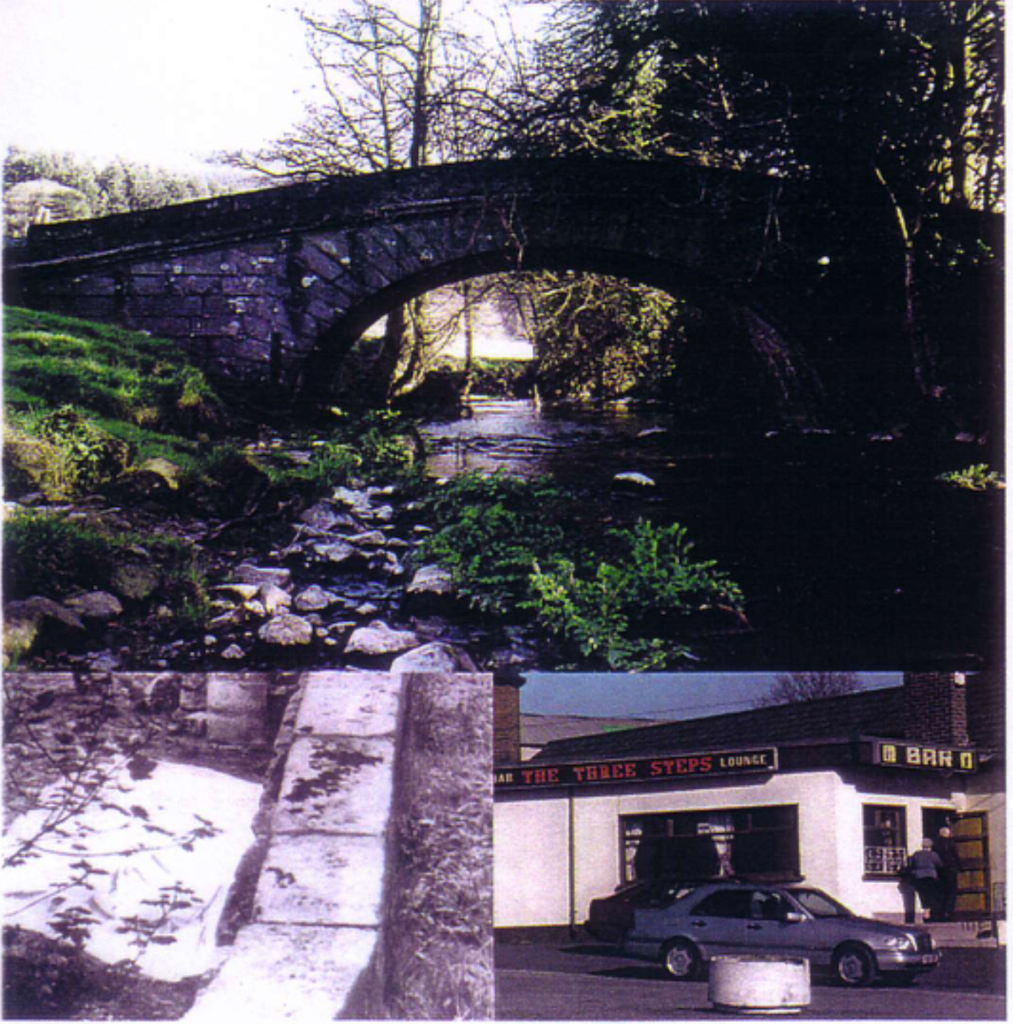 Clockwise from top:
The bridge over the River Flurry in Ravenside Forest where Nairac is supposed to have been shot;
The Three Steps Inn, scene of his abduction by the IRA;
A spot by the bridge where blood was found.
Later, however, he was noted to have been acting oddly. He made frequent visits to the lavatory. He was preoccupied with the disappearance of his cigarettes. Perhaps he was worried about a source meeting that had gone wrong or had a coded message written on the cigarette packet. The members of the pub band sensed Nairac was in danger and offered him a lift, but he refused.
Local IRA sympathizers had decided to abduct him, and as he left the pub Nairac was lynched, beaten and bundled into a car. Later, when they discovered his modified Browning 9mm automatic (stories vary: either he was carrying it in an underarm holster or it was found in his car), they knew he was a soldier of some description. If he’d followed standard back-up rules, this would not have happened.
Fred Holriyd believes Nairac’s attackers had known who he was all along. “They didn’t mind him being there because they didn’t regard him as great threat,” he says. “He was one man, he was irrelevant. They could take him at any time they wanted.” In fact, I was told by another source that the IRA had warned the SAS that Nairac was a target. Nairac had laughed off the threat.
Reports of Nairac’s condition when he was in the car vary: some state he was still alive and functioning; others suggest he was battered unconscious before even leaving the car park of The Three Steps. Either way, he was driven a short distance at high speed through a maze of lanes towards the border’. He received further beatings in an area called Ravensdale Forest, over in the Republic. A more senior IRA man, Liam Townson, was summoned from Dundalk. By the time he arrived, Nairac was half-dead.
Throughout his abduction, attack and torture, Nairac maintained that he was a member of the Official IRA (“a Stickie”) from North Belfast, named Danny. Even at the brink of death, as Townson aimed a gun at his head, he still insisted he was an IRA man and asked for a priest. At one point, he even managed to grab the weapon and aim at it his attackers; it misfired and he was beaten further with a wooden stake. After several further misfires – he had been drinking all day – Townson finally shot Captain Robert Nairac through the skull. What happened to his body next is not known. IRA sources claimed that Nairac was taken to a nearby meat-processing plant and treated “like any other carcass”. Others suggested a secret burial near Belfast.
Nairac’s disappearance caused panic in the ranks of the British Army. Such was the uncertainty about his death that some in the SAS believed he had defected to the IRA; there was even speculation that he would show up at an IRA press conference. It was also feared that before his death he had passed on information that would compromise British Army security.
In fact, rumours would later suggest senior IRA figures were furious that Nairac’s captors hadn’t realised the significance of the man they had killed and that no detailed information had been extracted from him. The IRA no doubt kept the body because it would have shown the heavy beating Nairac had taken; it was a violent mob attack not in line with more military-style executions. One person I spoke to alleged that the Garda and RUC found the suspects in the Nairac case so quickly because the IRA themselves had turned them in.
The IRA issued a statement, however, claiming Nairac had been kept alive for a while and interrogated fully and to their satisfaction before being executed. While it’s true that Nairac’s notebook, which he carried with him at all times and which contained details of his agents and operations, was never found, the rest is propaganda. During police interrogation, one suspect confessed that, despite all the brutality he administered, Nairac “never told us anything”. Years later, a more senior IRA man stated with authority that, ”The only thing even the IRA will admit is that he [Nairac] was a brave soldier.”
In 1978, Townson was sentenced to a mandatory life sentence. He was released after 12 years. The five other men charged with Nairac’s murder were brought to trial in Northern Ireland and given sentences ranging from five to 22 years; none served more than 10. Two other suspects fled, it is thought to the US.
The posthumous award of the George Cross in 1979 only added to his reputation. Almost 25 years after first meeting him, retired SAS Major Clive Fairweather still finds Nairac’s story compelling — and mystifying. “I think he was a sufficient breaker of rules to go alone [across the border] to cock a snook at everyone,” he says. “I often ask myself whether he simply had a death wish, or was he really a hero? We’ll never know. But, by God, he really pushed it to the limit.”
Some pictures taken from ‘Death of a Hero’ by John Parker (Metro Books).
Disclaimer
This article, written by Eamonn O’Neill, was originally published in Esquire, a British magazine/newspaper. However, as of now, no online version can be found, which is why we are sharing it here. It is possible that the article has been removed or is no longer available online. If you suspect any copyright infringement or violation of intellectual property rights, please contact us immediately, and we will take the necessary actions.