
HENRY realized he couldn’t just head to the barn on his own. Camila was far too eager to see the horses, and besides, he knew she would need warmer clothes and proper boots. It took longer than he liked to dig through closets and storage chests, but eventually they managed. Camila laughed at her reflection in the hallway mirror, insisting she’d never forgive him if anyone saw her dressed like that. The worst part was the rubber boots, two sizes too big, but her feet were snug inside with the help of two thick pairs of wool socks.
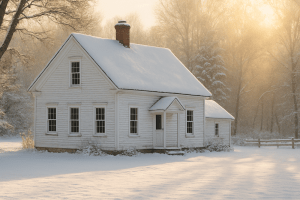
When they finally stepped outside, the cold air bit at their cheeks, and Camila’s eyes widened at the scale of the land around her. She had imagined something modest—yet here was a farm far larger than she expected. The farmhouse itself was simple, cozy, barely large enough for a small family. But the barn loomed enormous against the pale winter sky.
The dogs bounded ahead, their paws kicking up white powder as they darted back and forth, chasing each other and nosing into the drifts. Every so often they circled back, tails wagging, before tearing off again to lose themselves in the snow’s wild invitation.
Henry explained as they walked, slowly and with caution. “I bought the place about five years ago. The folks before me—good intentions maybe, but they were dreamers, not farmers. Hippies who thought they could live off the land without knowing the first thing about managing it.” He shook his head. “They let the horses graze wherever they pleased. Ate the grass down to nothing. By the time I came along, the paddocks were stripped bare, nothing but steppe across acres. The wind carried away what topsoil was left. The rains washed the rest downstream. Climate change hasn’t helped either.”
Camila listened closely as their boots crunched through the snow.
“The trick is simple,” Henry went on. “You keep horses on one paddock, then move them to another while the first recovers. It’s called rotational grazing.”
She nodded, impressed, while he continued.
“By the time the farm went on the market, nobody wanted it. Too much work. Too much damage to fix. So I bought it for a good deal.”
But Henry’s tone shifted, warming with conviction. “I had more in mind than just keeping horses. Mismanagement had scarred the land, but it’s still here. A hundred and ten acres. My mission has been to bring it back. Preserve the land. Drill for wells, restore water. Even reintroduce beavers to help rebuild wetlands. I’ve partnered with universities in New York and New England—they send students out here to lend a hand. The horses are just one small piece of it. They need me every day, of course—no matter the season. But the real project,” he said, looking across the fields, “is giving this land a second chance.”
They had almost reached the barn when Henry added, “Too many farms around here survive only by selling off pieces of their land for housing. It’s the only way they can keep afloat. Most are rich in assets but poor in cash. I’m trying to be a beacon, to show there’s another path. And after five years here, I’m finally hearing from other farmers who want a sustainable future too.”
He continued passionately, “Most farmers stick with corn because it’s a cornerstone of dairy feed, Vermont’s dominant farm industry. But it’s vulnerable if dry summers become the new normal.”
Camila looked at him, impressed. “Wow… you’re really into this.”
Henry grinned and gave a small nod. “Yup.”
Henry slid open the heavy barn door, the metal runners groaning softly as it moved. A rush of cool air drifted out, carrying the mingled scent of hay and horses. Inside, the barn stretched wide, with twenty stalls lining either side. Only three were occupied.
Camila was once again struck by the sheer scale of the barn. As they stepped inside, her gaze swept upward, and she couldn’t help but stare in amazement at the cavernous space.
Henry noticed her expression and smiled faintly. “The original builders must have had something grand in mind, but they never finished it. The upstairs is framed out like a ballroom—vaulted ceilings, wide open floor. These days, I’m only using a small corner of it as a hayloft.”
“At some point,” Henry said, pointing to the empty stalls, “I want to bring in rescue horses. The ones their owners have no more use for, too old for work, too slow for racing, or just unwanted. Let them retire here.” He paused, resting a hand on the railing. “I’m still figuring out how to balance that with the rest of my plans for the land. But the students have been a blessing. Couldn’t manage without them.”
He added with quiet realism. “And then there’s the money side of it. It’s under control for now, but only if I stay disciplined and keep my priorities straight.”
He gave a short laugh. “There’s a saying: when you have horses, you’re either rich or irresponsible. I’m neither. That’s where the challenge comes in.” He glanced at her with a half-smile. “And I’ve always liked a good challenge.”
He motioned toward the first stall. “This here is Dusty. Gelding. Solid quarter horse, strong shoulders, the kind you could ride all day and he wouldn’t quit.” The horse stepped forward, a dun with a dark dorsal stripe, his coat a pale golden brown that caught the light. His muzzle nudged curiously at Henry’s sleeve.
The next stall held a chestnut mare with a narrow blaze down her face. “And this is Rosita,” Henry said. “Gentle as they come, but she’s sharp. Learns fast, keeps the others calm.” Rosita flicked her ears toward Camila, then lowered her head, letting her fingers brush along her warm neck.
Finally, they stopped at the third stall. A striking grulla mare stood quietly, her coat a smoky gray with black points and a thick dark mane. “This one’s Luna,” Henry said softly. “She’s a little wary at first, but once she trusts you, she’s loyal through and through.” Luna’s dark eyes followed Camila’s movements, cautious yet curious.
Camila’s face lit up as she reached toward the horses one by one. “They’re beautiful,” she whispered, her voice carrying the reverence of someone who had once only dreamed of this moment.
Henry drank in her excitement—the way her smile lit her face, the sparkle in her eyes, the flush of her cheeks against the cold. For a fleeting moment, he let himself imagine this was the morning he had once dreamed of sharing with Alice. The anger and despair that had weighed on him earlier were gone, dissolved into the sight of Camila’s joy.
He pushed the thought aside and turned practical. “Alright,” he said, guiding her to the stalls. “We’ll start with the holsters and lead ropes. They’re hanging here on the side.” He showed her how to slip the strap over Rosita’s head, adjust it snugly, and fasten the buckle.
Camila’s excitement grew when he handed her the lead rope. “So I really get to help bring them out?”
“Of course,” Henry replied. “Just remember—always walk on their left side. And fold the rope like this.” He demonstrated, looping it carefully. “That way, if the horse spooks, it won’t catch your hand or wrist.”
Memories stirred in her mind. She recalled her grandfather’s stories about horses and how to handle them—lessons that had meant little to her back then, when she had never even seen one up close. Now, standing before the real thing, she finally understood what he had been trying to tell her.
Henry led Dusty, steady and dependable, while Camila walked proudly beside Rosita. Together they brought the horses into the paddock beside the barn. Then, with a small nod of encouragement, Henry let her take Luna on her own. The mare hesitated at first, but soon followed, Camila’s careful movements winning her trust.
When they returned to the barn, Henry grinned and gestured toward the now-empty stalls. “And now comes the really exciting part—mucking.”
Camila laughed, but without hesitation she caught up a wheelbarrow, grabbed the mucking fork, and plunged into the work. “Don’t think you’ll scare me off that easy,” she teased over her shoulder.
Henry chuckled, shaking his head, though a spark of admiration warmed his chest.
They worked steadily for the next hour, falling into an easy rhythm. Henry gave advice when it was needed—how to spread the shavings evenly, how full to leave the water buckets, how to stack hay so it lasted longer. Camila listened carefully, eager to learn, her laughter occasionally breaking the monotony as she struggled with a stubborn fork of hay or a bucket that sloshed too much.
By the time the stalls were cleaned, shavings replenished, water buckets filled, and the barn floor swept, her cheeks were glowing red from the cold and exertion. Henry noticed her shoulders trembling slightly as she leaned on the muck fork.
“Maybe it’s time we head back inside,” he said with a grin. “Hot shower for you.”
She rolled her eyes but didn’t argue.
Back in the house, Camila disappeared upstairs, while Henry retreated to his office. The hum of computers greeted him, rows of screens glowing with code and data. He became absorbed in his work until the sound of footsteps pulled him back.
Her head popped around the doorframe. She opened her mouth to say something but froze at the sight of the equipment filling the room.
“Whoa, Houston,” she said with a crooked smile, “we don’t have a problem.”
Henry chuckled. “Told you—I’m a cybersecurity expert. This is the workplace that pays for the farm.”
Camila nodded thoughtfully, then brightened. “How about a hot chocolate?”
“Would love one,” he said, swiveling back to his screen. “I’ll be right out—just need to close things up here.”
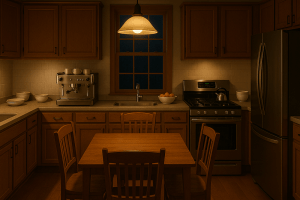
In the kitchen, Camila used the espresso machine’s steamer to froth and heat milk, pouring it over rich chocolate in two large cups. Soon they were sitting across from each other, steam curling above their drinks as Henry set a soft stream of jazz playing in the background.
They lingered there for a while, sipping slowly, the warmth of the drinks seeping into their hands and easing the morning’s chill. At last, Henry drained his cup, set it aside, and leaned back in his chair, folding both arms behind his head with a long, reflective sigh.
Camila watched him closely and sensed the moment had come—he was finally ready to share what he had promised. There was a weight in his posture, a hesitation in his eyes, as if he was gathering the courage to let the words out.
He closed his eyes as if to gather his thoughts. When he opened them, his voice carried a low weight. “I already told you, my wife Margaret got pregnant at a young age, and nine months later, we received our daughter.”
“Alice,” Camila assumed.
Henry shook his head. “Rebecca,” he said. “She grew up to be a very bright young woman. We lived in Boston then—Margaret and I both had good jobs, and there were excellent schools all around us. She went to Boston College, where she met her future husband. They married quickly.”
He glanced at Camila. “Sorry if I skip details. It’s a long story. But feel free to stop me if something needs clarification.” She nodded.
“About two years into their marriage, they had their first child, Adam. Four years later came their daughter, Alice.”
He paused. “I mentioned it before—Margaret and I were ready to separate, and in truth we had already drifted apart. We kept up the façade for the family—showing up for birthdays, for Christmas, pretending to be the happy couple. But behind it all, we lived separate lives.”
He drew a long breath, his throat tight. “Then came the worst day of my life. Rebecca and her husband Tim were killed in a car accident on the Massachusetts Turnpike.”
Camila released a low cry, covering her mouth in shock.
Henry nodded. “Margaret and I were babysitting when it happened. Adam was twelve, Alice only eight.”
Another pause. “The years that followed were… difficult. Both kids went through therapy. Adam coped by becoming disciplined, excelling in school, channeling his pain into achievement. He stepped into a protector role before he was ready, convinced it was his job to carry Alice through grief. He eventually went to law school, specializing in tax law. A bit too dry for my taste, but that’s Adam. He may appear stiff, but there’s more inside him than he lets anyone see.”
He continued: “Alice adored him as a child, but as she grew older, his seriousness felt suffocating. She coped by rebelling—drinking, experimenting with drugs, testing boundaries. Adam tried to stop her, sometimes lecturing, sometimes covering for her. But the harder he pushed, the more she resisted. Their fights usually ended in silence: Adam hurt by her recklessness, Alice angry at his judgment.”
Henry exhaled. “Adam left for college and law, while Alice slipped further into addiction. He sent her money, tried to get her into programs, even showed up uninvited to pull her out of bad situations. Each time she accused him of trying to control her life. And in between were us—the grandparents who were never meant to be parents again. We were much older, and both children had trouble accepting us in that role. Too often, we were treated as little more than bystanders.”
He looked down, voice heavy. “By the time Alice turned eighteen, the house had become a battlefield. Quiet most of the time, but ready to erupt when she came home late or not at all. She had been drifting for months—skipping shifts at her job, hanging around with people I didn’t trust, showing up at breakfast with glassy eyes and smoke on her clothes. She felt smothered under my rules and Adam’s watchful eye. Where he found discipline and direction, she only felt trapped.”
He shook his head slowly. “Leaving wasn’t sudden. It was years of friction boiling over. Alice called it independence. But it meant drifting between unstable friends, relationships, and jobs. For me, it was the pain of letting go—knowing she was too fragile but unable to force her to stay. For Adam, it was devastating. He carried it as a personal failure, believing that if he had been a better brother, she wouldn’t have walked away.”
Henry’s eyes softened. “Not long after Alice left, Margaret and I finally separated. Too much had broken between us. And in the wake of it all, I left Boston behind. Moved to Vermont. Bought land. Tried to make a new beginning after years of grief and disappointment.”
Camila looked at him with tears in her eyes. “Now it all makes sense.”
Unspoken thoughts pressed against her, though she wasn’t prepared to share them now. Doubt crept in slowly, threading through the recognition that much of this sounded familiar. She felt the weight of it, for Alice—and for Henry.
“Where are they now?”
Henry sighed. “Alice? I don’t know. She never looked back—just disappeared. Adam’s still in Boston, but his life has been a restless search for footing. He’s moved between good firms and short stints of freelance work, teaching, even odd consulting jobs, never staying long enough to put down roots. He visits from time to time but never understood why I left the city for this place. Still, I think he’s beginning to realize what he needs—something that makes his mind and discipline matter for more than empty achievement. I believe that truth is starting to sink in.”
They sat in silence for a while, letting the weight of the conversation settle. At last Henry stood, stretching the stiffness from his back.
“Let’s take a break from all that heavy talk,” he said. “Life is here, and it’s right now. I’ve got to finish up a small project, then it’ll be time to let the horses back in and think about supper.”
Camila nodded in agreement, needing a moment to let his words settle. When the weight of them eased, she looked at him and offered a small, relieved smile. “My turn to make supper.”
Henry raised an eyebrow. “Oh? And what’s on the menu?”
She brightened a little. “Arepas. With cheese, eggs, and sausage. Simple, but it will taste like home.”
“Wonderful,” Henry said, his voice warm with approval. “Haven’t had that in years. You’ll have to show me how it’s done.”
Camila laughed. “Only if you promise not to criticize my technique. My grandfather used to say the secret is not in the recipe but in the hands that make it.”
Henry nodded, his expression softening. “All right, the kitchen’s yours.”
He felt a buzz in his jacket pocket and pulled out his phone. After scanning the screen, he said, “Looks like most of the power’s back, and they’ll start clearing the smaller roads tomorrow morning.”
He glanced toward the road. “Mine is usually at the bottom of the list. So maybe tomorrow night, maybe the next morning. I’ll let them know there’s an abandoned car…”
Then he noticed the shadow darkening her expression, and the weight of his words sank in. “Camila,” he said gently, “you’re welcome to stay as long as you need.”
He grinned. “Quite a shift from how we started out, isn’t it?”
The attempt to lift her spirits fell flat. She didn’t answer, turned and walked slowly toward the stairs leading to her room.