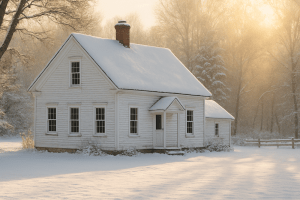
MORNING broke crisp and pale, the snow still heavy on the ground but softened by the sun’s first touch. A limousine was on its way, carrying the things Camila had asked for—clothes, shoes, and other necessities she had arranged through a few quick phone calls the night before. For now, she remained in borrowed layers, sleeves too long and fabric shifting awkwardly with every move. She insisted on joining Henry for the barn chores one more time.
Not many words passed between them, only a quiet understanding of what needed to be done. The steady rhythm of the work became its own refuge, a welcome distraction from the outside world and from the choices that loomed just ahead. It wasn’t a heavy mood that hung over them, but a kind of sober determination, as if both had silently agreed to meet whatever was coming with steady hands and clear minds. The scrape of tools, the shifting of hay, even the creak of the barn boards felt grounding—reminders that, for this moment at least, they were exactly where they needed to be.
The air inside the barn was sharp with hay and horse musk, and their work had the same rhythm as the day before—feeding, mucking, hauling. They carried the wheelbarrow out and tipped its heavy load onto the steaming manure pile, then leaned against the handles to catch their breath.
Henry’s laughter broke the silence. “You know,” he said, eyeing the way her clothes had bunched and sagged, “from here it looks like you’re about six months along.” Her hair was in disarray, and a few dirt smudges streaked across her face, making the image all the more convincing.
Camila blinked at him, then burst into laughter, clutching her belly as if cradling an unborn child. “¡Carajo! Si agarro al tipo que hizo esto…” She jabbed her finger at Henry, her voice carrying across the yard. “¡Todo es tu culpa!”
She bent forward, grimacing in mock pain, exaggerating the act and her voice echoed through the frosty air.
Henry chuckled, shaking his head at her theatrics. “You missed your calling,” he said, still grinning. “Hollywood would’ve paid good money for that performance.”
Camila straightened up, brushing snow from her clothes, her laughter trailing into a satisfied sigh. For a moment, the heaviness that had been hovering between them was gone, replaced by the easy warmth of shared mischief. Henry felt the knot in his chest loosen—relieved that the tension had lifted and, if only briefly, the thought of her leaving was forgotten.
They rolled the wheelbarrows back into the barn and set them aside before finishing their chores—sweeping the floor, checking the stalls, and making sure the horses were settled. The work left them drained, yet it was the kind of exhaustion that soothed the mind as much as it wore down the body. At the barn door they paused, side by side, their breaths rising in pale steam, their cheeks flushed from the cold and the labor. For a long moment they stood there, letting the stillness settle around them, before deciding, wordlessly, to head back to the house.
Inside, they settled by the fire with steaming cups—her hot chocolate, his tea. The flames crackled steadily, dogs curled near the hearth, the winter light fading beyond the windows. Their talk stayed light, circling around the weather, the horses, and small jokes from the chores earlier in the day. Neither of them reached for deeper subjects; it was as if by unspoken agreement they kept to the comfort of the moment, protecting it from the weight of what the future would bring.
After their cups were empty and the fire had burned lower, they decided on a short walk around the property. The snow was crusted firm underfoot, crunching softly with each step. Their breaths rose in pale clouds, drifting away in the still, cold air. Neither spoke much; the silence between them felt less like distance and more like a quiet understanding.
Camila pulled her coat tighter and let her eyes wander across the open fields, the fences, and the line of woods beyond. It was a stark landscape, stripped bare by winter, yet it carried a serenity she had never known before. Her mind drifted back to the night before, when Henry had led her outside despite the freezing temperatures. She could still feel the sting of cold on her cheeks, the sharp bite of the air in her lungs, and the warmth of his presence beside her. Together they had looked up, breaths steaming, and she had gasped aloud at the sheer sweep of the stars—more than she had ever seen in her life. A sky so wide and endless it seemed to fold her into something larger than herself. The city had always felt like the center of the world, but here, under a sky without end, it seemed small and distant, almost unreal.
Now, walking in the pale daylight, the memory pressed against her heart. This quiet, simple life felt like a different world—one of horses, snow, and skies unspoiled by city lights. Yet she knew the limousine would soon arrive, pulling her back into another existence: crowded schedules, relentless demands, and the constant pull of an audience that never let her breathe. The contrast left her thoughtful, almost torn, as if she were caught between two lives that could never truly meet.
The crunch of their steps filled the silence as they circled the property, both lost in thought. Camila’s chest felt tight—not from the cold, but from the weight of what she carried inside. She knew she couldn’t live this life forever, not with the commitments waiting for her, but she also knew she couldn’t allow herself to walk away from Henry as she once had from her grandfather. That regret had followed her like a shadow, a wound that never fully healed.
Camila stopped walking, snow crackling beneath her boots as she turned to Henry. Her voice was steady, but her eyes betrayed the weight of her thoughts.
“Henry,” she said softly, “do you remember what you told me? About dreams—that you never give up on them. You don’t burn them to ashes, and you don’t let cobwebs grow over them.”
He glanced at her, caught off guard by the sudden shift in her voice. For a moment he studied her expression, then gave a small, thoughtful nod, as if acknowledging more than just her words.
Her eyes shimmered, not with tears this time, but with determination. “I won’t make the same mistake again. I promise you—I will come back. Not just to visit, but to make this a reality. A dream worth holding onto.”
The wind stirred, catching a strand of her dark hair and brushing it across her cheek. She tucked it behind her ear and smiled faintly, though her voice trembled when she spoke again. “I can’t let you become another person I lose. Not like before. This time, I will hold on.”
She hesitated, then pressed on, her gaze dropping for a moment. “But I have to be honest—I’m still full of doubts. My life out there… it’s not simple. I don’t know if I’m ready to leave it, or if I even can. Every step forward feels like another decision waiting to be made, and I don’t know where they’ll lead. That problem isn’t solved yet.” Her eyes lifted again, catching the winter light. “But I see things differently now. For the first time, I believe I can find a way. The right way.”
Henry looked at her quietly for a long moment, the cold air between them filled with words neither of them said. Then he gave a slow, steady nod, the kind that carried both acceptance and belief.
“Dreams don’t just happen. They are built piece by piece,” he said.
He drew a long breath, his eyes on her, then shifted his gaze out across the snowy fields. When he spoke, his voice was quiet but steady.
“You know, Camila… when you first showed up here, I thought it would be nothing more than a few days of helping someone through a storm. I didn’t expect you to change anything in me. Truth is, I had stopped expecting much of anything at all. My days were chores, my nights were silence. I told myself I was content, but really, I was just waiting out the clock.”
He looked back at her, his expression softening. “Then you came along with your laughter, your stubbornness, your way of filling a room without even trying. You reminded me I’m still capable of more than routine. You reminded me of Alice, of my own family, and of the pieces of myself I’d let drift into the background.”
Henry paused, the words almost catching in his throat before he pushed on. “When I told you not to let dreams turn to ashes or gather cobwebs, I wasn’t just talking about you. I was talking about me, too. Somewhere along the way, I let mine slip away. But you… you pulled me back to them. To the idea that maybe it’s not too late to hope for something better. To share something real.”
He gave a faint smile, one that carried both pride and a hint of vulnerability. “So when you say you’ll come back—don’t think of it as a promise only for you. If you do, you’ll be keeping a promise for me too. Because now… I see there’s still room in life for dreams, even at my age. You opened that door for me.”
They embraced, neither willing to let go, the cold forgotten as the silence between them filled with everything words could not carry. The stillness of the snowbound fields made it easy to pretend this life could last, but somewhere beyond the hills, engines were already humming her back to another world. It wasn’t until the distant crunch of tires on packed snow reached their ears that they slowly pulled apart.
Together they walked back toward the house, boots sinking into the white crust, until the gleam of black metal came into view. A massive Hummer had turned into the driveway and rolled to a stop in front of the garage. A uniformed chauffeur stepped out, shut the door firmly, and moved to the rear. With practiced ease he pulled out a large suitcase and set it on the snow.
Spotting them, he straightened and called out, “Miss Valentina?”
Camila raised her hand slightly. “Yes.” Her voice was calm, but Henry caught the flicker of tension behind it. They moved toward the vehicle side by side.
Henry’s brow furrowed as he eyed the oversized car. “What is this?”
Camila gave a small laugh, her shoulders loosening. “Told them it had to be a four-wheel drive… and that it should not be white.”
Henry shook his head, a grin tugging at his mouth. “Good thinking.”
The chauffeur carried the suitcase inside, declined Henry’s offer of warmth and coffee, and returned to wait in the Hummer. Camila knelt by the case, rummaging through its contents until she found clothes she liked. Without a word, she gathered them up and disappeared upstairs.
Henry remained at the kitchen table, staring absently at the wood grain, his thoughts circling in quiet loops. He lifted his head only when he heard her steps on the stairs. His mouth opened slightly in surprise.
Camila wore tight jeans and a bright, colorful sweater, thick and warm, the kind that seemed to carry its own light against the winter gray. Catching his expression, she laughed. “I think I’ll miss your wife’s clothes. They were very… airy.”
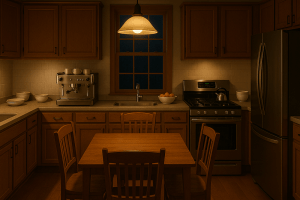
Henry only smiled faintly, still struck by the change in her. She crossed to the counter without asking, started the machine, and soon placed another latte in front of him. In the foam she had drawn a small heart. He stared at it for a moment, then looked up at her, but she had already taken her seat across the table.
For a few minutes they talked about nothing—weather, the horses, the quiet around them—as if stretching out the time by avoiding the one subject that mattered. Then Camila rose, drew a thermal jacket from the suitcase, and called for the chauffeur. He reappeared, hefted the suitcase with ease, and carried it out to the car. Opening the passenger door, he stood waiting.
But she didn’t follow right away. Instead, she lingered on the porch, waiting for Henry to join her, the dogs pressed close at her heels. He stepped out without a jacket, the cold brushing against him unnoticed. Neither spoke. Together they stood in silence, their eyes fixed on the winter landscape stretched out before them. The air was sharp, the snow still bright in the fading light, and for a moment everything felt suspended.
Then Camila turned her head toward him. “So,” she asked with a playful wink, “what’s your next dream now? Now that I’ve opened the door for you.”
Henry smiled, his eyes still fixed on the horizon. “Alice,” he said simply.
Camila’s eyes widened, her face brightening with approval.
“Not sure how much effort I can invest,” he admitted after a pause, nodding toward the barn. “The work here never ends. It’s going to be a challenge.”
Camila started to reply, but he cut her off with a small grin. “And yes—I’ll keep you posted.”
“If there’s anything I can do to help,” she said softly, “just tell me.”
Henry met her gaze and gave a firm nod, the kind that carried both gratitude and resolve.
They stood together for another long minute, the quiet of the snow-covered fields wrapping around them. Neither wanted to break the stillness, but at last the truth settled between them—it was time to part ways.
She turned and wrapped her arms around Henry, pressing her head to his chest. “I love you, old man.”
He grinned, though his throat tightened. “I love you, young woman.” Then he bent and placed a gentle kiss on her forehead.
She held on a second longer before reluctantly letting go. Her steps toward the car were slow, as if each one took effort. At the door she turned back once, lifted her hand in a wave, then slipped inside. The engine hummed to life, and the vehicle rolled down the long driveway, its taillights flickering between the trees until they vanished from sight. Even then, he kept his eyes on the empty road, listening to the quiet creak of the trees as if they, too, were waiting for her return.
Henry stayed on the porch, the dogs pressed against his legs as though they, too, felt the change. The silence returned heavier than before, but it wasn’t loneliness—only the ache of parting. He drew in a breath, tasting the cold air, and let his hand rest on the nearest dog’s head.
“Well,” he said quietly, “it’s just the three of us again, guys.” Yet somewhere beneath the ache was something steadier: the certainty that he wasn’t the last man alive in Vermont after all.