SHE woke with a start, her body half-twisted in sheets that weren’t hers. For a moment she panicked—the slant of the ceiling, the smell of wood smoke, the faint ticking of pipes all wrong. She sat up, heart pounding, her gaze fixed on the dark until her eyes caught the faint square of yellow on the door cast by the night-light low in the room.
You are safe. Bathroom is on the right, the note read in large letters.
Her hands trembled as she flicked the switch. The sudden light burned her eyes, and her stomach lurched. She pressed her palm to her mouth, but the nausea surged anyway. She stumbled to the bathroom, gripping the doorframe, retching into the sink until the sour taste made her gag harder. When it was done, she rinsed with shaking hands, staring at the pale, drawn face in the mirror. Eyes rimmed red, sweat at her hairline. She hated how weak she looked.
Out in the hall, another yellow square caught her eye. Kitchen is downstairs.
She hesitated, hugging her arms across her chest. Her skin prickled as if the air were too cold, but she knew it was just her nerves sparking. Every sound seemed sharper than it should be. The boards creaked too loud beneath her bare feet as she crept down. Another note waited at the frame. Kitchen to the left.
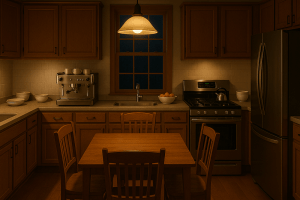
From there she saw it: a soft glow spilling into the hall, the quiet clink of porcelain. She pressed her back to the wall, listening, her breath shallow. A faint bitter craving coiled in her chest—she knew exactly what would steady her hands, what would push back the shivering inside. But there was nothing. Just this strange farmhouse, the sour taste still on her tongue, and the faint hiss of water about to boil.
She edged forward. An old man stood at the counter, pouring steaming water into two mugs, side by side, his movements unhurried, practiced. Two golden retrievers lifted their heads from a rug near the stove and padded over to her, tails swaying gently. She crouched for a moment, brushing her hands across their warm coats, but the effort felt heavy, her energy already spent. The dogs seemed to sense it; after a brief nuzzle they wandered back to their bed, circling once before curling up together in the glow of the fire.
She looked at the man across the kitchen, his appearance clean and composed, wearing faded jeans held up with a suspender and wearing a plaid shirt. The look struck her as steady, almost old-fashioned. Something about him tugged at a distant place in her memory, a sense of familiarity too faint to name. The thought wavered, then slipped away—she was too weak to hold onto it.
Henry turned, his expression measured, the hint of a smile there but held back, as though offered out of courtesy rather than ease. “I heard you getting up,” he said. “Tea?” He lifted the mug slightly, steam curling between them.
She froze in the doorway, arms still wrapped across her chest. The smell reached her, sharp and earthy, and her stomach rolled again. For a second she shook her head, lips parting as if to refuse. But the warmth of the kitchen, the steadiness in his eyes, the thought of something safe and ordinary pressed against the tremor in her chest. Slowly, she let her arms fall to her sides, stepped closer, and took the mug from his hand. It was almost too hot, but the weight of it grounded her, and she managed a faint, uncertain nod.
Henry set his own mug on the counter and kept his voice even, almost careful. “You had an accident,” he said. “Your car went off the road and hit a tree. Do you remember?”
She blinked, staring into the rising steam as if it might hold the answer. Fragments tugged at her—headlights in snow, the sudden spin, a cracking sound that seemed to split her skull in two. But when she tried to pull the pieces together, the nausea swelled again, and she gripped the mug tighter to steady her hands.
“I… I don’t know,” she whispered, her throat dry. It frightened her, the gaps, the way her mind slid off the memory as though it had never belonged to her. The craving gnawed just beneath the surface, sharper now, whispering that it could make the confusion fade if only she had more. She shut her eyes for a moment, willing it away.
When she opened them, Henry was still watching her with that same calm steadiness. She managed the smallest shake of her head. “I remember the car spinning,” she said at last, “but not much else.”
Henry nodded but said nothing.
“Where am I?” she asked.
“The middle of nowhere,” he said. “My farm—about ten miles outside Poultney, Vermont.”
“Vermont…” she whispered, as if testing the word.
She shifted her weight from one foot to the other, her eyes drifting around the room. It was still dark outside; the windows showed only the faint reflection of the lamp. On the wall above the counter, a clock ticked softly. 4:35 a.m.
“Why are you up so early?” she asked, her voice hoarse.
“I couldn’t sleep,” he said simply.
She lowered her gaze to the steaming mug in her hands. “I’m sorry. I’ll leave first thing in the morning.”
He shook his head, almost a quick dismissal. “No way. The roads are blocked for at least the next two or three days. Besides, your car isn’t going anywhere without repairs. Sorry, you’re stuck with me. But that doesn’t mean you need to hang out with me. The guest room has a TV, and I’ll give you my laptop so you can contact whoever you want.”
She clutched the mug tighter. The idea of being trapped here made her chest tighten. The craving in her gut stirred restlessly, whispering its need. Still, she tried to cover it with a faint nod.
Henry paused before adding, “The power lines are down. Don’t expect help from anyone out there.”
Her brows knitted. “But you still have lights.”
“I do,” he said, a trace of irritation sharpening his tone. “This house has advanced backup systems. Solar, battery banks, generators. Enough to keep things running. I prepared for this kind of situation.” His voice carried the edge of a man who’d explained this too many times before and didn’t care to again.
She studied him, sensing the wall in his tone. The kitchen was warm, but her skin still prickled with unease. She forced herself to meet his eyes. “Thank you for rescuing me.” Her throat tightened, and she added softly, “My name is Camila.”
She stretched out her hand, fingers trembling slightly from more than the cold. Henry looked at it, then at her, but didn’t take it. “Henry,” he said, and reached for his own mug instead.
Camila wavered for a moment, then finally asked, “At some point, can we go down to my car? I need to get a few valuable things.”
Henry shook his head almost immediately. “There’s no way. It’s not safe out there right now. Too far away, too much snow, and it’s dangerous. We can’t risk it.”
He paused, and something in his eyes darkened, a flicker of old pain just beneath the surface. His voice was quieter now, but weighted. “Look, I saw the injection marks. Don’t tell me it’s from a doctor’s visit. I’ve seen this before.”
He took a breath, the memory of someone else’s struggle shadowing his tone. “If you’re looking for your stash, you won’t find it. You’re going to have some very difficult days ahead.”
Camila stared at him, shocked and a little defensive. “I’m not a junkie,” she said, her voice tight.
Henry just nodded slightly, a shadow of sorrow behind his eyes. “Okay, I’ve heard that one before,” he said, not unkindly, but with a heaviness that hinted at a story he wasn’t telling. “Just focus on getting through this.”
He hesitated, the mug lingering in his hand as he measured his words. He realized he might have come off a bit too harsh, and he softened his tone. “Look, I’m just an old man who is not used to having company. I’m not a monster. You’re safe here, I promise. Let’s just make the best out of this.”
He offered a small, more genuine smile, an attempt to bridge the gap and ease the tension he’d unintentionally created.
She let out a breath she didn’t realize she’d been holding and managed a faint nod. “Okay, I kind of thought you weren’t,” she admitted, glancing toward the retrievers now curled up together. “My grandfather always told me that if people don’t like you, that’s fine. But if the dogs don’t like you, that’s when you worry. And I’ve looked at your dogs.”
She offered that small piece of wisdom, and Henry’s eyes softened a touch. “Your grandfather was a wise man,” he said quietly.
Camila nodded, a faint, bittersweet smile crossing her lips. “Yes, he was,” she murmured. The memory seemed to linger in her mind for a moment, but the exhaustion and unease quickly returned. “I’m not feeling well. I think I need to go back upstairs,” she said softly.
Henry gave a brief nod. “Of course. Help yourself to anything you need. I’ll be having lunch and dinner later, but you don’t have to join me unless you want to. Just let me know if you need something.”
With a small word of thanks, she turned and made her way back upstairs, leaving Henry alone in the quiet kitchen. He watched her go, then took his tea and sat down at the table, lost in thought. A faint smile tugged at the corners of his mouth, a mixture of old memories and the strange comfort of having someone else in the house, even under these odd circumstances.