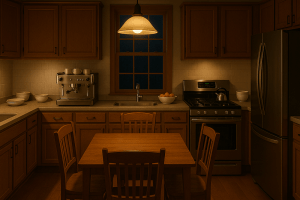
THE farmhouse stood alone in the cold winter night, its windows glowing faintly against the darkness. Snow stretched unbroken across the fields, hard and glittering under the pale wash of moonlight. The wind cut sharp through the trees, carrying with it a low, mournful whistle. Now and then, a branch cracked under the weight of ice, echoing across the emptiness. Beyond the fence line, there was nothing but shadows and silence, the house itself standing like a solitary beacon in a frozen world.
Outside, the night pressed hard against the farmhouse, wind hissing through the trees and snow piling higher against the windowsills. But inside, the old walls held fast against the storm, keeping their small pocket of warmth intact.
Henry Callahan cradled the warm mug in both hands, letting the steam rise and fog his glasses before he took a slow sip. The kitchen was cozy in the way old farmhouses could be when someone had poured years of work into them—beams exposed but polished, a stove that hummed with quiet efficiency, and the faint smell of cedar from the firewood stacked neatly by the door.
Beyond the frosted windowpanes, winter pressed against the glass. Snow fell in lazy, endless sheets, and the fields were hidden under a pale shroud. Henry liked evenings like this, when the world seemed to hush itself. He could almost believe he was the last man alive in Vermont.
And in that quiet, Henry’s thoughts drifted to his ex-wife. She’d never had much patience for this kind of rural solitude. Vermont farm life had been his dream, not hers. She’d wanted the city, the buzz of people, the kind of life where nature was a park you visited, not a wilderness you lived in.
He didn’t begrudge her for it. They’d parted ways on good terms, each understanding that the other needed something different. She was living the life she’d always wanted now, and so was he. Taking care of animals, tending to the land, living in sync with the seasons—this was his sanctuary.
And on a night like this, he never imagined the stillness of his world could ever be disturbed.
Then the headlights appeared.
He noticed them far off, just a pair of dim flickers cutting through the falling snow. His brow furrowed. What the hell is someone doing out here tonight? The road that wound past his place wasn’t much more than a suggestion on a map, and in this weather, it was all but impassable. Even the plows gave up once the drifts piled too high.
The lights advanced, slow and uncertain, vanishing for a heartbeat into the curtain of snow before flickering back to life. They seemed to edge closer, then waver away as if passing by, nearly swallowed by the dark, only to lurch forward again—until at last they stopped suddenly—too suddenly. A heartbeat later came the sound: a hollow, distant bang carried on the frozen air. Henry straightened, his gut tightening.
Damn it. That wasn’t a tree branch. That was metal against something it shouldn’t have met.
He set his mug down, the tea forgotten. Instinct told him to reach for the phone, to call it in. But then he pictured the dispatcher’s voice, polite but firm: roads closed, response time uncertain. Maybe hours. Maybe longer.
So what? Leave them out there?
Henry rubbed a hand over his jaw, already feeling the decision press down on him. The farmhouse was warm, safe, the kind of place a man could wait out any storm. But there was no comfort in ignoring the thought that kept repeating in his head: If it were me in that ditch, I’d damn well hope someone would come looking.
He reached for his truck keys, then pulled on his heavy winter jacket, tugged his hat low, and worked his hands into thick gloves. The cold bit at him as he stepped into the garage, snow already drifting under the door. He climbed into the truck, turned the ignition, and to his relief the engine caught immediately, rumbling to life despite the bitter temperature.
The truck groaned as Henry coaxed it down the narrow road, tires crunching through drifts that rose nearly to the hubs. The windshield wipers beat a frantic rhythm, barely keeping pace with the heavy snow. Every hundred yards he wondered if he should turn back. What if I get stuck too? What if I can’t even find the damned car?
But then he’d catch a faint impression in the whiteness—what might be tire tracks, already half-swallowed by the storm—and he pressed on. His knuckles ached against the steering wheel.
Ten minutes felt like an hour before the faintest glimmer caught his eye: a pale light glowing beneath the snow, where the banks had collapsed around some buried shape. He braked hard, the truck skidding sideways before finding traction.
“Christ Almighty,” he muttered, shoving the gear into park.
The cold bit at him the moment he opened the door. Henry pulled his coat tighter, tugged his hat low, and shoved his gloved hands into the drift. He dug like a man desperate for air, snow stinging his face until the shape revealed itself: a white sports car, low to the ground, its sleek lines useless against winter’s fury.
A BMW, still running and purring softly, its hood speckled with melting snowflakes, had slammed into a large tree; the front end was crumpled with serious damage, yet the engine stubbornly kept alive, though he couldn’t yet see who was inside.
Henry fought his way around to the driver’s side. The door was frozen stiff, but with a grunt and a heave he wrenched it open. The dome light flickered, revealing a woman slumped over the wheel.
His stomach clenched.
She was young, her skin a warm bronze against the pallor of the storm, dark hair spilling in loose waves across her coat collar, dressed in what almost looked like a ski suit, her lipstick and mascara smudged and streaked across her cheeks. She looked so still that for a breath Henry thought she was gone. He pressed two shaking fingers against her neck, unsure if he’d even know what to feel. Then—relief. A faint rise and fall of her chest, the whisper of breath against the cold.
“She’s alive,” he whispered, and then, louder: “Goddamn it.”
He wasn’t a medic. He wasn’t even sure if moving her was safe. But leaving her here was worse. He slipped his arms beneath her shoulders and dragged her free, wrestling for a moment with the deployed airbag. With his thick gloves stiff from the cold, it took him an extra effort to fumble open her seatbelt before he could fully pull her out. Her weight was awkward but not unbearable as he maneuvered her free.
He quickly checked for any signs of blood, relieved to find none. She was unconscious but didn’t seem physically injured. Snow clung to her lashes as he half-carried, half-dragged her to the truck. He settled her gently into the passenger seat and carefully pulled the seatbelt around her, then shut the door firmly against the wind.
Back at the BMW, Henry checked the backseat, the trunk, every crevice he could reach without tools. Nothing. No bags, no phone, no papers. It was as if the car had fallen from the sky with her in it. He reached in to switch off the engine, pulled the keys free, and tucked them into his jacket pocket.
A gust of wind howled through the trees, reminding him how quickly the storm was sealing everything back under ice. He cursed again, clambered into the driver’s seat, and turned the truck toward home.
The return crawl was worse than the first. Twice the wheels spun wildly, once the truck slid sideways into a ditch before clawing back onto the road. Henry kept glancing at the unconscious woman, terrified she’d stop breathing in the seat beside him. By the time he nosed into the garage, his shirt was damp with sweat despite the bitter cold.
He drew a deep breath, bracing himself for the task ahead, then opened the truck’s passenger door. Releasing the seat belt, he eased the young woman into his arms. For a moment he considered slinging her over his shoulder but dismissed the thought—it would only make the doorway harder to manage. Awkward as it was, he carried her close and wrestled the house door open, managing it with effort.
Inside the farmhouse, the heat wrapped around them like a blessing. He approached the staircase leading to the guest room upstairs and, with effort, made the first unsteady steps upward.
He paused more than once to catch his breath, easing her down only to hoist her up again. Each lift sent a jolt through his back, and the thought followed like a shadow: I’m too old for this. At the door he fumbled, the knob refusing to turn, and the weight in his arms felt heavier with every second—her body, and his years pressing down on him alike.
Once inside the room, he lowered her gently onto the bed, steadying her limp form as though she might break. She didn’t stir, only breathed—steady, fragile. He pulled a thick wool blanket over her, tucking it tight, then stepped back, hands on his hips.
Now what, Henry?
For the first time, he really looked at her. She was younger than he’d first thought—mid-twenties, maybe. Her features were striking: high cheekbones, full lips, a fine-boned nose, all framed by that cascade of dark hair. Her skin held the warm undertone of distant sunlit lands, and there was a grace to her even in unconsciousness, as if sleep alone couldn’t dim her spirit.
She looked utterly out of place here, in his farmhouse room with its pine paneling and handwoven rug. A woman from another world, dropped into his solitude.
Henry rubbed a hand over his face, the weight of the night pressing in. What the hell have you brought into your house?
He stood there for a moment, the young woman now resting under the wool blanket. He let out a slow breath, feeling the weight of uncertainty pressing in. Normally, he’d pick up the phone and call the doctor in the nearest village some ten miles away, but tonight was different. The whole area was blacked out—no electricity for miles, and he knew well enough that nobody nearby had an internet or cell connection right now.
He glanced at his own setup—his house, thankfully, was a little fortress of technology, with backup batteries and a satellite link keeping his own connection alive. If he couldn’t reach a human doctor, maybe his AI assistant could at least give him some guidance.
He hurried downstairs into his cramped office, a room cluttered with blinking monitors, tangled cables, and stacked papers—a space that resembled less an office and more a flight control center on the edge of chaos.
“Tell me what I need to do to keep her stable,” Henry murmured, as he pulled up the AI interface on his computer screen. He described what had happened on the road, how he’d found her unconscious in the car, and gave his best account of her condition—breathing but unresponsive, no visible injuries, and cold from the snow. The assistant responded with calm, clinical advice: check her breathing, keep her warm, and—if possible—get her out of any cold, wet clothes. He’d need to get her into something dry like pajamas.
Henry hesitated, feeling a flush of discomfort. “You’ve got to be kidding me,” he muttered to himself. But there it was. He knew it had to be done, even if it made him feel like he was crossing some awkward line.
Back in the guest room, he opened the closet. His wife, who still visited a couple of times a year, always left a few things behind. To his relief, a folded set of pajamas sat on the shelf. They looked a little too large for the slender young woman he had pulled from the wreck, but they would have to do.
He checked the closet again and unearthed a pair of slippers, bright with faded sequins and far too garish for his taste. Groaning in distaste, he admitted they would have to do. Carrying them back, he placed them on the floor beside the bed, where she would find them when she got up.
He glanced again at the woman lying on the bed. I should clean her face first, he thought, before the smudges get everywhere. In the bathroom he dampened a sponge, then returned and gently wiped the streaks from her cheeks and hands. He wasn’t sure if it truly mattered, but at least it felt like he was doing something for her—some small act of care while he waited for what came next.
He moved carefully, unzipping the top of her ski suit and slipping it off her shoulders. Underneath, she wore a long-sleeved shirt, and as he gently removed that as well, he glanced down and then froze. “Oh, hell,” he breathed. A flood of unwelcome memories surged through him, sharp and relentless. “I can’t go through this again.”
For a moment, he felt he couldn’t go on—frozen in place, his body paralyzed while his thoughts raced in a storm of confusion. There on her arm were faint marks—just a hint of something he remembered with horror. He hesitated, torn between fear and obligation, but pushed himself to continue for the young woman’s sake. When he was done, he lingered, studying her face. She was beautiful—so achingly familiar, just like Alice had been before he lost her. The thought cut deep; losing Alice had been the last straw, the fracture that sealed the end of his marriage. A swell of tears threatened, but he forced them back. For now, he had done enough. The rest would have to wait.
He left the guest room and stepped into the bathroom, deciding to face the mirror. The reflection staring back at him was harsher than he expected—deep lines cut across his face, his jaw rough with gray stubble, and his hair refused order no matter how he smoothed it. A shave, maybe even a bit of tidying up, might help, though he knew it would not turn back the years. Don’t want to scare her half to death when she wakes up, he thought, the crooked smile that followed more weary than amused.