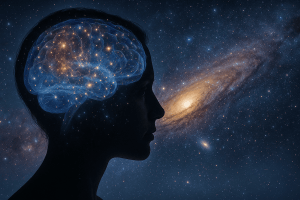
Excerpt from The Lucid War Chronicles
by William Forth
Dr. Miriam Locke strode down the long, polished corridors of Stanford University’s neuroscience building, her heels clicking in a steady rhythm that mirrored her thoughts. Her reputation preceded her—a trailblazer in sleep science, known for her intense focus and groundbreaking experiments on altered states of consciousness. Some called her brilliant, others eccentric, but no one could deny the impact of her work. Today, she was about to embark on her most ambitious project yet.
Reaching the designated conference room, Dr. Locke paused briefly, smoothing the front of her tailored navy blazer. The room beyond the frosted glass door was already alive with quiet murmurs. The five participants were waiting, each chosen with surgical precision after months of careful vetting. They were, as her research assistant had quipped, the “dream team” in every sense of the phrase.
Dr. Locke opened the door with a deliberate push, her entrance silencing the murmurs. The room was sleek and modern, with a large oval table at its center. The five students sat spaced evenly around it, each eyeing her with varying degrees of curiosity and apprehension.
“Good afternoon,” she said, her voice calm yet commanding. She walked to the head of the table and placed a leather-bound folder in front of her. “I’m Dr. Miriam Locke. You’ve all been selected for this experiment because you possess a unique skill: the ability to lucid dream.”
She paused, letting the statement settle in. A few of the students exchanged glances, but no one spoke.
“Before we dive into the specifics,” Dr. Locke continued, “allow me to tell you a little about myself and why you’re here. I’ve dedicated my career to understanding the mechanics of sleep and consciousness. Dreams, in particular, are a gateway—a bridge between the unconscious and the conscious mind. But lucid dreams are something even more extraordinary. They’re not just dreams; they’re a form of controlled reality. And that, my dear students, is what we’re here to explore.”
Her eyes swept the room, making brief but direct contact with each participant. “You’ve all been chosen through a rigorous selection process. Your ability to consistently experience and control your dreams sets you apart from the average dreamer. What we’re about to do will push the boundaries of what science understands about the human mind.”
Dr. Locke gestured to the students. “But before I provide you with more details, I want to hear from you. Introduce yourselves to each other. Tell us your name, what you’re studying, and—if you’re comfortable—how you discovered your talent for lucid dreaming.”
There was a brief silence before one of the students leaned forward.
Gabriela Martinez was the first to speak. Her dark brown eyes sparkled with a mix of confidence and curiosity.
“I’m Gabriela Martinez,” she began. “I’m a cognitive neuroscience major, and I’ve been fascinated by the brain ever since I was a kid. My abuela had Alzheimer’s, and watching her memories slip away made me want to understand how the mind works.”
She glanced at Dr. Locke before continuing. “As for lucid dreaming, I discovered it when I was about fourteen. I had a recurring nightmare about being trapped in a burning building. One night, I realized I could change the dream. I imagined a fire extinguisher, and just like that, the flames disappeared. It was… liberating.”
Gabriela’s voice trailed off, and she leaned back in her chair, her story hanging in the air.
Next, Aiden Kapoor adjusted his glasses nervously. His dark hair was neatly combed, and his hoodie suggested someone more at home with code than conversation.
“Uh, I’m Aiden Kapoor,” he said, his voice soft but steady. “I’m studying computer science with a focus on AI and machine learning. I’m interested in how technology can interface with the human brain.”
He pushed his glasses up his nose before continuing. “I got into lucid dreaming by accident. I was experimenting with meditation apps, and one of them had a section on dream control. At first, it felt like a weird side hobby, but when I started coding algorithms to track and analyze my dreams, I realized it was more than that. It’s like hacking your own brain.”
Aiden smiled awkwardly and sank back into his chair, clearly relieved to have finished his turn.
Chloe Armstrong was next. She had a quiet intensity about her, with a shock of platinum-blonde hair and a septum piercing that gleamed under the fluorescent lights.
“I’m Chloe Armstrong,” she said, her voice steady and deliberate. “I’m double majoring in philosophy and psychology. My interest in lucid dreaming started as a philosophical question: What does it mean to be conscious? I started keeping a dream journal to explore my own thoughts, and before I knew it, I was having lucid dreams almost every night.”
Chloe paused, her expression thoughtful. “To me, lucid dreams are a way to confront parts of myself I can’t access in waking life. It’s like holding up a mirror to your soul.”
Omar Al-Rahman was the fourth to speak. His broad shoulders and easy smile made him seem approachable, but his voice carried an edge of authority.
“I’m Omar Al-Rahman,” he said, his Syrian accent faint but noticeable. “I’m studying bioengineering. I want to design medical devices that make healthcare more accessible, especially in places like where I grew up.”
Omar’s smile softened as he continued. “Lucid dreaming was something I discovered as a teenager. My family went through some tough times, and dreaming became an escape. When I learned I could control my dreams, it was like finding a sanctuary no one could take away. Now, I want to see if that sanctuary can be used to help others heal.”
Finally, Jasmine Okafor sat up straighter in her chair. Her bold, colorful scarf framed her face, which radiated energy and enthusiasm.
“I’m Jasmine Okafor,” she said, her voice bright and clear. “I’m a biology major focusing on sleep science. I got interested in this field because my mom struggled with insomnia for years. Watching her battle sleepless nights made me realize how much we take sleep for granted.”
She grinned. “As for lucid dreaming, it started with a dream about flying. I was maybe twelve, and I suddenly realized I could control where I went. It was… incredible. Since then, I’ve been trying to learn more about how and why it happens.”
Dr. Locke listened intently to each introduction, her expression giving away nothing but her focused interest. When Jasmine finished, she straightened and clasped her hands in front of her.
“Thank you all for sharing,” she said. “Your stories highlight exactly why you’ve been chosen for this experiment. Lucid dreaming is a deeply personal experience, but it also holds universal potential. Our goal is to tap into that potential, to understand how lucid dreams can be harnessed for therapeutic, cognitive, and even creative purposes.”
Dr. Locke’s tone grew more serious. “But I won’t lie to you. This experiment will push you to your limits. It will challenge your understanding of reality and self. If any of you have doubts, this is your opportunity to walk away.”
The room was silent. No one moved.
“Good,” she said, a small smile playing at the corners of her lips. “Then let’s begin.”
The Lucid War Chronicles
by William Forth
The Lucid War Chronicles tells the gripping story of individuals who master lucid dreaming to achieve extraordinary feats in their respective fields. Among them is Elena Rivera, a determined archaeologist unearthing the mysteries of Ravenstone Keep in the quaint English village of Waverly. Through her dreams, she connects with historical figures and uncovers long-buried secrets. Meanwhile, Dr. Miriam Locke, a celebrated neuroscientist and psychologist, leverages her team’s lucid abilities to solve a chilling murder in Sacramento.
Their remarkable skills, however, do not go unnoticed. Soon, they find themselves arrested and confined to a clandestine black site, severed from the outside world. But the dreamers refuse to be silenced. Over time, they unite, craft an escape, and spark a global conflict—a war between dreamers and non-dreamers. For those who dare to dream, this is where the story begins. More information…