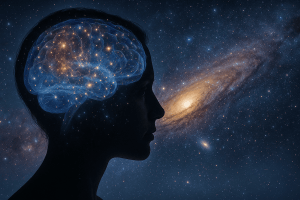
Excerpt from The Lucid War Chronicles
by William Forth
The auditorium at Boston University buzzed with quiet anticipation. Students filled the rows, some clutching notebooks while others balanced coffee cups precariously on their knees. Professors sat near the front, murmuring to one another. But it was the cluster of individuals scattered throughout—dressed in sharp, tailored suits—that drew subtle glances. Their polished presence felt out of place among the academic crowd, their expressions unreadable as they scanned the room with almost clinical detachment.
Dr. Miriam Locke stepped onto the stage, her presence commanding yet approachable. She adjusted the microphone, her navy blouse catching the light, and gave the audience a small, confident smile.
“Good evening,” she began, her voice calm and steady. “Thank you all for being here tonight. Today, we’re going to talk about something that has fascinated humanity for millennia: dreams.”
She paused, letting her gaze sweep the audience.
“It has been said that the human brain is the most complex structure in the known universe. Despite decades of research and technological advances, we have yet to fully understand its mysteries. Among those mysteries are dreams—a phenomenon as universal as it is enigmatic. Why do we dream? What do our dreams mean? And perhaps most intriguingly, can we control them?”
Dr. Locke clicked a button on her remote, and a vivid image of the brain’s neural pathways appeared on the large screen behind her.
“Our brains are extraordinary processors of information. Every second, our senses register a staggering amount of data from the world around us. But we don’t consciously perceive all of it. In fact, most of it is filtered out, leaving only the most significant details for our conscious minds to process. This filtering is essential; otherwise, we would be overwhelmed by sensory input.”
She gestured to the image on the screen.
“However, the information we don’t consciously notice doesn’t simply vanish. It’s stored—at least temporarily—in our brains. Dreams, I believe, are one way that this hidden data resurfaces. They’re like a filing system, where fragments of information, emotions, and memories come together in ways we don’t fully understand.”
She took a step forward, her tone growing more animated.
“And then there’s lucid dreaming. A phenomenon where the dreamer becomes aware that they are dreaming and can, to varying degrees, influence the dream’s content. Lucid dreaming offers a unique opportunity: the chance to actively interact with these hidden fragments of our subconscious. For example, imagine visiting Times Square, your senses overwhelmed by the crowd, yet in a lucid dream recalling that you passed a celebrity like, for instance, Asher Beaumond walking toward you—someone your conscious mind had only registered as an ordinary person in the throng.”
She caught snippets of delighted sighs and whispered giggles ripple through the crowd at the mere mention of the actor’s name, and a sly smile crept across her lips.
The slide changed to an image of a person sleeping, surrounded by artistic renderings of dream imagery.
“Lucid dreaming isn’t a new concept,” Locke continued. “Historical references to it can be found in ancient Greek philosophy, Tibetan Buddhist practices, and even in the writings of figures like Aristotle. Tibetan monks developed meditation techniques to achieve dream awareness as part of their spiritual practices, while modern researchers have used lucid dreaming to explore everything from trauma therapy to creative problem-solving.”
A murmur spread through the audience as she clicked to the next slide: a list of notable figures known for their vivid dreams, including Salvador Dalí, who famously drew inspiration from his dreams for his surrealist art.
“But what exactly is a lucid dream?” she asked rhetorically.
“A lucid dream occurs when you become aware that you are dreaming while still within the dream itself. This awareness allows you to manipulate the dream to some extent. You might choose to fly, revisit a childhood memory, or confront a fear. The key is maintaining that delicate balance: staying asleep while keeping the conscious mind engaged.”
The next slide displayed a series of steps, and Locke pointed to them with her remote.
“There are ways to encourage lucid dreaming. Techniques like reality checks—asking yourself throughout the day whether you’re dreaming—can prime your mind to recognize the dream state. Keeping a dream journal is another powerful tool; it helps you notice recurring themes or symbols in your dreams, which can act as cues for lucidity. Finally, techniques like the MILD method—Mnemonic Induction of Lucid Dreams—use affirmations and visualization to set the intention of becoming lucid before you fall asleep.”
She turned back to the audience, her expression thoughtful.
“But here’s the thing: even with these techniques, lucid dreaming is not fully understood. Why does it occur in some individuals more than others? Why are some dreams easier to control than others? And perhaps most importantly, what is the full potential of lucid dreaming? Can it be harnessed not just for personal exploration but for scientific discovery, therapeutic breakthroughs, or even creative innovation?”
The screen went dark, leaving her illuminated in the spotlight.
“These are the questions my research seeks to answer. Dreams—and lucid dreams in particular—are more than just a nightly phenomenon. They are a frontier, a space where the boundaries between the conscious and unconscious blur, and where the untapped potential of the human mind might just reside.”
The room erupted into applause. Locke gave a small bow of gratitude, but as the clapping subsided, her eyes flickered briefly to the men in suits scattered throughout the auditorium. Their expressions remained unreadable, but their presence gnawed at the edges of her thoughts. Who were they, and why did they care about her research?
As the applause died down, a line of students and faculty began forming near the podium, eager to ask questions or share their thoughts. Locke answered them patiently, her demeanor warm and engaging. She spoke at length about her methods, the ethical implications of lucid dreaming, and the potential it had for improving mental health and creativity. But as she addressed the crowd, her gaze occasionally flickered back to the suited individuals.
One of them lingered near the back, watching her with an intensity that sent a faint chill down her spine. His presence felt different—not quite hostile, but not friendly either. It was as if he were evaluating her, weighing every word she said.
After the Q&A session ended, Locke gathered her notes and began packing up. The auditorium had mostly cleared, but one of the suited men approached her, his movements deliberate.
“Dr. Locke,” he said, extending a hand. His voice was smooth, his grip firm. “Excellent presentation. Your work is… fascinating.”
“Thank you,” Locke replied cautiously.
“I represent an organization that takes a keen interest in emerging fields of study,” he continued. “Lucid dreaming, in particular, holds significant potential for applications beyond what most researchers consider. We’d like to discuss your work further.”
Locke’s instincts bristled. “And who, exactly, do you represent?”
The man smiled faintly but offered no answer. Instead, he handed her a card with a number printed on it, unadorned by any name or logo.
“Think it over,” he said before turning and walking away.
Locke stared at the card, unease coiling in her stomach. The man’s demeanor and the cryptic nature of his message left her with more questions than answers. As she slipped the card into her pocket and exited the auditorium, she couldn’t shake the feeling that she’d just stepped into something far larger than she had anticipated.
The Lucid War Chronicles
by William Forth
The Lucid War Chronicles tells the gripping story of individuals who master lucid dreaming to achieve extraordinary feats in their respective fields. Among them is Elena Rivera, a determined archaeologist unearthing the mysteries of Ravenstone Keep in the quaint English village of Waverly. Through her dreams, she connects with historical figures and uncovers long-buried secrets. Meanwhile, Dr. Miriam Locke, a celebrated neuroscientist and psychologist, leverages her team’s lucid abilities to solve a chilling murder in Sacramento.
Their remarkable skills, however, do not go unnoticed. Soon, they find themselves arrested and confined to a clandestine black site, severed from the outside world. But the dreamers refuse to be silenced. Over time, they unite, craft an escape, and spark a global conflict—a war between dreamers and non-dreamers. For those who dare to dream, this is where the story begins. More information…